
Call Quality Assurance Software: Reviewing Only 1% of Calls Is No Longer Enough
The Quality Assurance Bottleneck
Every customer conversation contains valuable information. A sales opportunity, a compliance risk, a dissatisfied customer, or an exceptional service interaction can all happen during a single phone call. For organizations that depend on customer communications, these conversations represent one of the richest operational data sources available.
Despite their importance, the vast majority of Contact Centers still evaluate only a very small percentage of recorded calls. Supervisors spend hours manually selecting conversations, listening to recordings, completing scorecards, and providing coaching sessions based on what they have reviewed. While this methodology has been accepted for decades, it was designed for a completely different business environment.
Today’s operations generate thousands—or even tens of thousands—of customer interactions every day. Under these conditions, manual Quality Assurance processes struggle to keep pace. The result is a growing operational bottleneck where managers are expected to make decisions about agent performance, customer experience, and compliance using information that represents only a tiny fraction of total conversations.
The Hidden Bottleneck Inside Every Quality Assurance Department
Quality Assurance has always played a critical role in Contact Center operations. Supervisors evaluate conversations to verify that agents follow company procedures, comply with regulations, maintain service quality, and deliver consistent customer experiences.
In theory, this process provides valuable feedback that helps improve performance across the organization. In practice, however, the effectiveness of Quality Assurance depends entirely on the number of conversations that can actually be reviewed.
Most organizations simply do not have enough time or personnel to evaluate every recorded interaction. A supervisor may spend several minutes reviewing a single call, completing an evaluation form, documenting observations, and preparing coaching recommendations. Multiply that process across hundreds of agents handling dozens of calls every day, and the workload quickly becomes impossible to sustain.
This operational reality forces Quality Assurance teams to make compromises. Rather than evaluating the complete customer journey, they select a small sample of conversations that they believe represents overall performance. Although this sampling approach has been considered an industry standard for years, modern communication volumes have exposed its limitations.
Tú podrías estar interesado...
Marcación interna directa permite a las empresas asignar varios números de teléfono a un único sistema PBX, lo que permite a los clientes contactar directamente con empleados o departamentos específicos. Cuando se realiza una llamada a un número DID, la PBX la enruta a la extensión designada sin requerir la intervención de una recepcionista.
Este sistema se integra con tecnologías VoIP y basadas en la nube, ofreciendo funciones avanzadas como desvío de llamadas, correo de voz a correo electrónico y análisis en tiempo real. Las empresas también pueden configurar reglas de enrutamiento de llamadas para garantizar que las consultas de los clientes se dirijan a los equipos adecuados, mejorando la eficiencia general de la respuesta.
Why Most Contact Centers Review Only 1% to 3% of Customer Calls
Many organizations are surprised when they calculate the actual percentage of conversations reviewed by their Quality Assurance teams.
A medium-sized Contact Center may process thousands of inbound and outbound calls every week. Even highly experienced supervisors can manually review only a limited number of recordings during their working hours. After accounting for meetings, coaching sessions, reporting responsibilities, and operational support, the amount of time available for listening to calls becomes remarkably small.
As a result, many organizations evaluate somewhere between 1% and 3% of their total conversations.
Although this percentage varies depending on company size and available resources, the underlying challenge remains the same. Supervisors simply cannot listen to every interaction without dramatically increasing staffing costs or sacrificing other operational responsibilities.
This creates an uncomfortable reality. Business decisions involving agent performance, customer satisfaction, process compliance, and operational improvement are often based on a sample that may not accurately reflect what is happening across the entire organization.
The Operational Risks of Blind Sampling
Reviewing only a small fraction of conversations creates operational blind spots that affect nearly every department within a Contact Center.
When managers lack visibility into the majority of customer interactions, they lose opportunities to identify emerging trends before they become larger business problems. Coaching sessions become reactive instead of preventive, compliance issues remain undetected longer than expected, and customer experience initiatives rely on incomplete information.
Several common challenges emerge from this approach:
- Agent mistakes may continue for weeks before being identified through a manually selected recording.
- Sales opportunities and successful communication techniques often go unnoticed because they were never included in the sample.
- Coaching programs are frequently designed using incomplete operational data rather than comprehensive performance insights.
These limitations extend beyond Quality Assurance itself. Operations managers depend on QA reports to evaluate training effectiveness, workforce performance, customer satisfaction, and service consistency. When those reports reflect only a tiny percentage of conversations, strategic decisions become more difficult to validate.
Why Traditional Quality Assurance Models Can No Longer Keep Up
Customer expectations have changed dramatically over the last decade. Businesses now compete through customer experience as much as through products or pricing. Every interaction has the potential to strengthen loyalty, generate revenue, or damage a company’s reputation.
At the same time, communication channels have expanded. Customers contact businesses by phone, mobile applications, websites, digital campaigns, CRM integrations, and omnichannel support environments. Voice conversations remain one of the most valuable sources of customer insight, yet they have also become one of the most difficult assets to analyze manually.
Increasing the number of Quality Assurance supervisors is rarely a sustainable solution. As call volumes grow, staffing requirements increase proportionally while operational costs continue rising. Eventually, organizations reach a point where manual auditing simply cannot scale efficiently.
This explains why many operations leaders are shifting their focus away from reviewing more calls manually. Instead, they are exploring technologies capable of evaluating every conversation automatically, transforming Quality Assurance from a sampling exercise into a continuous operational intelligence process.

How Artificial Intelligence Is Redefining Call Quality Assurance
For years, organizations have tried to improve Quality Assurance by refining evaluation forms, updating scorecards, or assigning additional supervisors to review calls. While these initiatives can improve consistency, they do not solve the underlying operational challenge: the inability to evaluate every customer interaction.
The issue is not the methodology itself. Manual evaluations remain valuable for coaching and performance management. The limitation lies in scalability. As Contact Centers grow, the number of conversations increases much faster than the capacity of QA teams to review them.
Artificial intelligence changes this equation completely.
Instead of relying on human reviewers to decide which conversations deserve attention, AI analyzes every interaction automatically. This transforms Quality Assurance from a reactive process based on limited sampling into a continuous monitoring system capable of identifying opportunities and risks as they occur.
This evolution allows organizations to shift their focus from listening to calls toward acting on the insights generated from those conversations.
From Statistical Sampling to Complete Conversation Analysis
Traditional Quality Assurance assumes that reviewing a representative sample is enough to understand the overall performance of a Contact Center. While this approach made sense when communication volumes were lower, modern customer service operations produce far more interactions than manual review can realistically cover.
Artificial intelligence introduces a fundamentally different model.
Rather than selecting random recordings, AI processes every inbound and outbound conversation as part of a continuous analysis workflow. Each interaction becomes another source of operational intelligence, allowing managers to evaluate performance using complete datasets instead of statistical assumptions.
This broader visibility changes how organizations measure quality. Instead of asking whether a small sample appears satisfactory, supervisors gain confidence that every customer conversation has been evaluated according to the same objective criteria.
As a result, performance trends become easier to identify, coaching priorities become clearer, and operational decisions rely on evidence gathered across the entire customer experience.
What Can AI Detect Across 100% of Customer Calls?
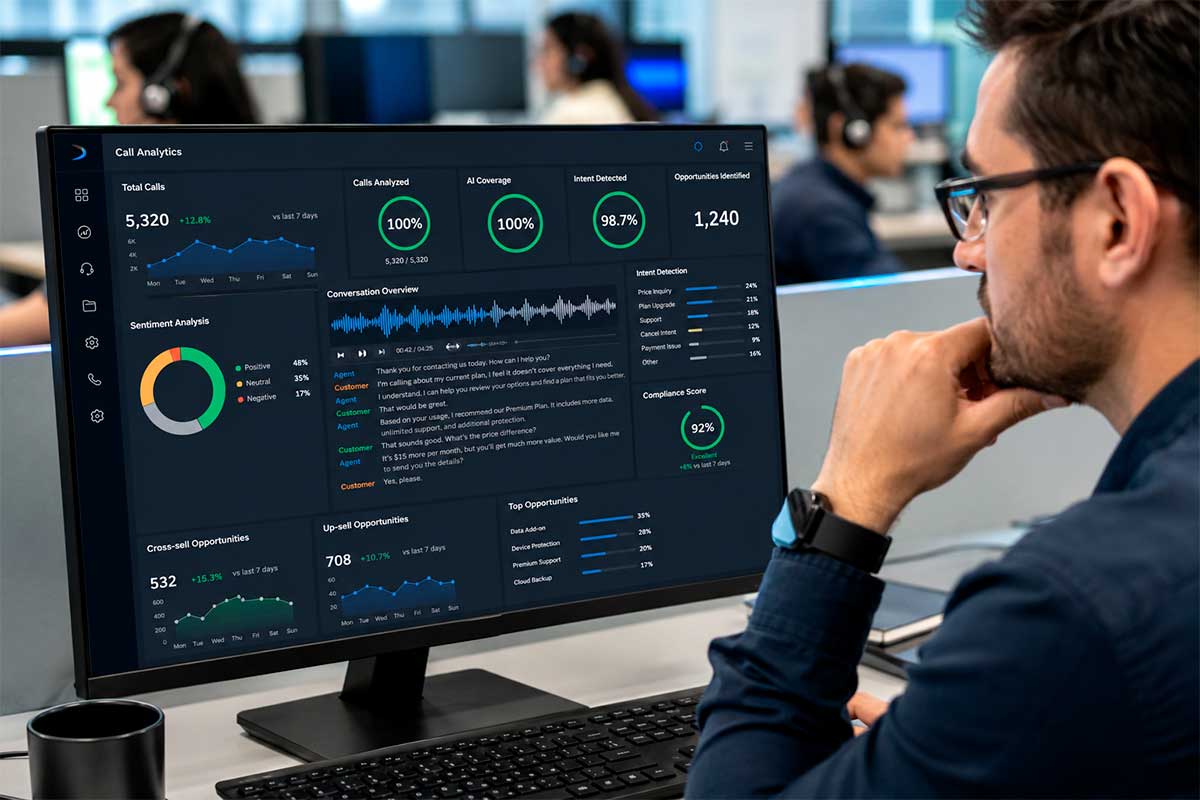
Modern call quality assurance software extends far beyond call recording or keyword searches. Artificial intelligence can analyze multiple dimensions of every conversation simultaneously, helping organizations identify patterns that would be impossible to discover through manual reviews alone.
Among the most valuable capabilities are:
- Automatic transcription of every inbound and outbound conversation.
- Customer sentiment analysis to detect positive, neutral, or negative interactions.
- Identification of compliance violations or required script omissions.
- Detection of recurring customer concerns and emerging service trends.
- Automatic quality scoring based on predefined business criteria.
- Recognition of successful sales techniques and customer retention opportunities.
Because these analyses occur consistently across every interaction, organizations eliminate much of the subjectivity associated with traditional Quality Assurance. Every agent is evaluated using the same standards, regardless of who supervises the team or when the conversation took place.
This consistency improves confidence in performance evaluations while providing managers with a much more reliable picture of overall operational health.
Transforming Quality Assurance with Vocametrics
Once organizations understand the limitations of manual call reviews, the next step is finding a solution capable of scaling Quality Assurance without increasing operational complexity. Modern Contact Centers require technology that evaluates conversations continuously, produces objective metrics, and helps supervisors focus on improvement instead of spending hours listening to recordings.
This is where Vocametrics becomes part of a new generation of call quality assurance software.
Rather than functioning as a conventional call recording platform, Vocametrics applies artificial intelligence to analyze every inbound and outbound conversation that flows through the CloudXentral communications infrastructure. Each interaction is automatically processed, eliminating the operational bottleneck created by manual sampling while giving supervisors complete visibility into customer communications.
The result is a Quality Assurance process built on comprehensive operational data instead of assumptions derived from small statistical samples.
Conclusión
The traditional Quality Assurance model served Contact Centers well when call volumes were manageable and manual reviews could provide a reasonable picture of overall performance. In today’s business environment, reviewing only 1% to 3% of customer conversations creates operational blind spots that affect coaching, compliance, customer satisfaction, and strategic decision-making.
Modern call quality assurance software addresses this challenge by replacing statistical sampling with continuous conversation analysis. Artificial intelligence enables organizations to evaluate every interaction objectively, identify operational trends faster, and generate insights that support ongoing improvement across the entire Contact Center.
Within this new approach, Vocametrics helps organizations transform Quality Assurance into a data-driven process by automatically auditing conversations, generating AI-powered analytics, and providing supervisors with actionable information instead of isolated recordings. Combined with CloudXentral’s Cloud Call Center, businesses gain an integrated communication environment where every customer interaction contributes to measurable operational intelligence and long-term service excellence.
FAQS
AI is designed to enhance the work of Quality Assurance teams rather than replace them. Automation handles conversation analysis at scale, while supervisors focus on coaching, performance improvement, operational strategy, and employee development using objective information generated by the system.
Conversation intelligence refers to the use of AI to analyze customer interactions and extract meaningful operational insights. It helps organizations understand customer behavior, identify trends, improve agent performance, and make data-driven decisions based on real conversations instead of isolated samples.
Artificial intelligence analyzes every conversation automatically, generating transcriptions, quality scores, sentiment analysis, topic detection, and compliance insights. This allows organizations to monitor communication quality continuously while reducing the manual workload for supervisors.
Small samples may overlook recurring customer issues, compliance risks, coaching opportunities, and successful communication practices. Decisions based on limited data may not accurately represent what agents and customers experience across the entire operation.
Most Contact Centers manually evaluate between 1% and 3% of recorded conversations due to time and staffing limitations. While this approach has been common for years, it often leaves significant operational blind spots and provides an incomplete view of overall performance.
SÍGUENOS EN YOUTUBE
Tú podrías estar interesado...
The Quality Assurance Bottleneck Every customer conversation contains valuable information. …
Top Call Providers in 2026 Choosing a business communication provider …
How Can I Incorporate AI Into My Company Many business …
Cloud PBX for Business USA Business communication in the United …
 ES
ES  EN
EN