
Law firm client intake PBX: How attorneys route, capture, and manage high-value calls in 2026
Law firm client intake PBX
A potential client may spend twenty minutes comparing attorneys, reading reviews, checking practice areas, and reviewing a law firm’s website before finally deciding to call. At that point, the firm has already invested in SEO, paid advertising, referrals, reputation, and content to generate the inquiry. The commercial risk begins when that caller reaches the phone system and cannot quickly connect with the right person.
Un Law Firm Client Intake PBX helps structure what happens between the first ring and the beginning of the legal intake process. The system can organize extensions, call routing, transfers, queues, mobile access, voicemail, and alternative destinations so that important inquiries do not depend entirely on whether one attorney happens to be sitting at a desk.
For law firms in 2026, the telephone remains part of the client acquisition journey rather than a separate administrative channel. A strong communication structure should help move a caller from initial inquiry to the attorney, intake specialist, paralegal, or legal team best prepared to handle the next step.
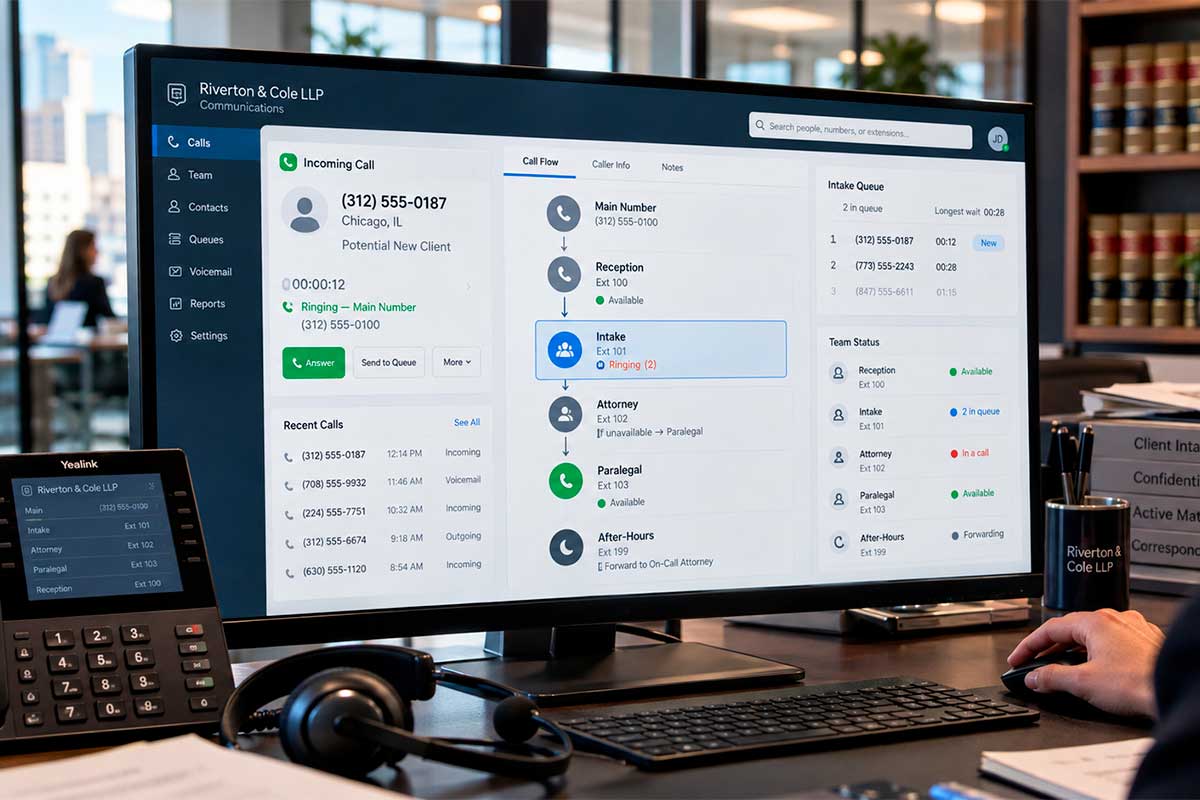
What is a law firm client intake PBX?
A Law Firm Client Intake PBX is a business phone environment configured around the way a legal practice receives, categorizes, routes, and manages client calls. It combines core PBX functions with an intake strategy designed around different callers, departments, locations, schedules, and levels of urgency.
The important distinction is configuration. A generic office phone system may simply ring several extensions, while a legal intake structure can define how new prospects, existing clients, urgent matters, and administrative calls should move through the firm. That distinction becomes especially important when attorneys are regularly in court, meeting clients, working remotely, or moving between offices.
El PBX for Lawyer service can fit into this architecture by giving legal teams access to business extensions, call forwarding, transfers, queues, voicemail-to-email, mobile connectivity, and centralized communication management. Those capabilities become more valuable when they are configured around the firm’s actual intake process instead of treated as isolated phone features.
Tú podrías estar interesado...
Marcación interna directa permite a las empresas asignar varios números de teléfono a un único sistema PBX, lo que permite a los clientes contactar directamente con empleados o departamentos específicos. Cuando se realiza una llamada a un número DID, la PBX la enruta a la extensión designada sin requerir la intervención de una recepcionista.
Este sistema se integra con tecnologías VoIP y basadas en la nube, ofreciendo funciones avanzadas como desvío de llamadas, correo de voz a correo electrónico y análisis en tiempo real. Las empresas también pueden configurar reglas de enrutamiento de llamadas para garantizar que las consultas de los clientes se dirijan a los equipos adecuados, mejorando la eficiencia general de la respuesta.
Why legal intake calls require a different routing strategy
Legal calls can carry very different levels of urgency, complexity, and commercial value. A prospective personal injury client may be calling several firms after an accident, while an existing corporate client may need to reach a specific attorney regarding an active matter. Sending every caller through the same path can create delays and unnecessary transfers.
The routing strategy should reflect why the person is calling and who is qualified to handle that request. A new prospect may first need an intake specialist who can collect basic information, while an existing client should usually reach the legal team already familiar with the matter.
Three common legal call flows illustrate why this distinction matters
New client inquiries: route prospects toward intake specialists or personnel prepared to collect initial information and determine the appropriate next step.
Existing client calls: connect current clients with the attorney, paralegal, department, or extension responsible for the active matter.
Urgent or after-hours matters: apply defined escalation, forwarding, or alternative routing rules when the standard office workflow is unavailable.
The objective is not to make intake more complicated. A well-designed routing structure removes unnecessary decisions from the caller and gives the firm more control over where each type of inquiry goes.

How attorney call routing protects high-value inquiries
A law firm may receive dozens of calls each day, but those calls do not carry equal business value. Some relate to scheduling, vendors, documents, or general information, while others represent a new case that could become a significant client relationship.
Attorney call routing helps protect these high-value inquiries by reducing the dependence on one receptionist or one physical phone. Routing rules can direct a call toward an intake team, another available professional, a queue, or a designated backup destination based on the structure the firm has defined.
The commercial advantage is speed and continuity. When a prospect is actively evaluating attorneys, long delays or repeated transfers can increase the chance that the person ends the call and contacts another firm. The PBX cannot guarantee that every caller becomes a client, but it can remove avoidable friction from the moment when the prospect is ready to speak.
How missed legal calls can become lost opportunities
Marketing teams often describe products using internal terminology, while customers describe the same needs in completely different language. Calls provide direct access to the vocabulary buyers naturally use when explaining problems, asking questions, or comparing alternatives.
A software company may promote advanced integration capabilities, while prospects repeatedly ask whether implementation requires internal IT resources. A communications provider may emphasize features while customers focus more heavily on reliability, onboarding, response times, or scalability.
Analyzing those conversations can improve market understanding because teams are working with language that appeared naturally during real interactions. This does not turn Voice of Customer analysis into keyword research; it provides qualitative and quantitative context about how customers frame their priorities.
How a PBX supports remote legal intake teams
Legal practices increasingly operate with distributed teams. Attorneys may work from court, home, satellite offices, or client locations, while intake specialists and administrative staff may be located elsewhere. The phone system needs to reflect that operating reality.
A cloud-based PBX can help maintain one business communication structure while users access it from different locations and devices. This allows the firm to keep the intake journey attached to the business rather than to one physical office phone.
Three scenarios are particularly relevant:
Attorneys outside the office: business extensions and forwarding can keep lawyers reachable without forcing the client to search for another number.
Remote intake specialists: intake personnel in another office or location can participate in the same inbound call structure.
Hybrid legal teams: attorneys, paralegals, receptionists, and intake specialists can operate through one coordinated communication environment.

Should attorneys use personal numbers for client calls?
Using personal mobile numbers may seem convenient, particularly for small firms or solo practitioners, but it can make communication harder to manage as the practice grows. Calls, messages, follow-up activity, and client expectations become attached to an individual device rather than to the firm’s communication structure.
A business extension provides more control because the attorney can remain reachable while the firm keeps the professional number inside its PBX environment. Calls can be transferred, forwarded, redirected, or handled through another configured destination without forcing the client to memorize different personal numbers.
This separation also improves continuity when attorneys change roles, take leave, or become unavailable. The business can adjust routing rules while maintaining the same client-facing number and internal structure.
What happens when the attorney is unavailable?
Attorney availability is one of the most common challenges in legal communication. Lawyers spend significant time in hearings, meetings, depositions, court appearances, consultations, and other situations where they cannot answer a call immediately.
A strong intake architecture assumes that unavailability will happen and defines what comes next. The caller might be transferred to an intake specialist, another attorney, a queue, or voicemail depending on the nature of the inquiry and the firm’s rules.
El PBX for Lawyer can support this type of structure through features such as call forwarding, call transfer, hunt groups, call queues, voicemail-to-email, and mobile extensions. The value comes from designing those functions around the firm’s actual workflow so that attorney availability does not determine whether an important inquiry reaches a useful destination.
How law firms should handle after-hours calls
After-hours intake should be designed around the needs of the practice area. A business law firm may have different requirements from a criminal defense, immigration, personal injury, or family law practice where callers may seek help outside standard business hours.
The firm should define what happens when the office is closed instead of allowing every caller to reach the same generic voicemail. Different categories of inquiry may justify different routes.
Standard after-hours inquiry: send the caller to voicemail or another defined follow-up process for the next available business period.
Urgent legal inquiry: apply forwarding or escalation according to the firm’s internal policies and staff availability.
Existing client matter: follow the communication rules established for active cases and current clients.
How call logs and recordings can support intake management
Call logs can help firms understand how many calls enter the business, when they arrive, which destinations receive them, and where communication patterns may require review. That operational visibility can be useful when evaluating staffing, intake procedures, or recurring missed-call periods.
Call recording can provide additional context where legally and professionally appropriate, but firms need to evaluate applicable consent laws, privacy obligations, internal policies, and professional requirements before recording conversations. The technical availability of a recording feature does not automatically make every legal call suitable for recording.
The broader value of centralized administration is that the firm can manage communication as an operational system rather than a collection of disconnected devices. This becomes increasingly important as the number of attorneys, offices, remote workers, and intake channels grows.

How PBX for Lawyer fits into legal client acquisition
Legal marketing creates attention, but the intake process determines what happens when that attention becomes a direct inquiry. SEO, paid media, referrals, directory listings, reputation, and content can all generate calls, yet the value of those channels can be reduced when callers struggle to reach the right person.
La PBX for Lawyer service should be viewed as part of the infrastructure connecting marketing activity with the people responsible for converting inquiries into consultations and potential cases. Extensions, forwarding, call routing, queues, mobile access, and voicemail are operational tools that support that connection.
The strongest implementation focuses on reducing unnecessary steps. A new client should reach intake efficiently, an existing client should have a logical path to the assigned team, and an unavailable attorney should have a defined backup route.
FAQS
A Law Firm Client Intake PBX is a business phone system configured around the intake process of a legal practice. It manages extensions, routing, transfers, queues, mobile access, voicemail, and alternative destinations so that different types of calls can reach the appropriate person or team.
The appropriate system depends on the size, practice areas, staffing model, locations, call volume, and intake process of the firm. A cloud PBX can be useful when the practice needs centralized business numbers, extensions, routing, mobile access, and communication across distributed teams.
New client inquiries should generally follow a defined intake path rather than being transferred randomly between attorneys. The firm can route prospects to an intake specialist, designated team, queue, or other configured destination based on practice area, availability, and internal procedures.
Yes. Cloud PBX environments can support remote access through mobile or desktop applications, extensions, and forwarding, depending on the platform configuration. This allows attorneys to remain connected to the firm’s business communication system while working away from the office.
Law firms can review routing rules, backup destinations, queues, forwarding, staffing schedules, voicemail processes, and follow-up procedures. The objective is to ensure that an unavailable attorney does not automatically become the end of the caller’s journey.
SÍGUENOS EN YOUTUBE
Tú podrías estar interesado...
Law firm client intake PBX A potential client may spend …
AI Voice of Customer Analysis Companies spend significant resources on …
Contact Center Call Abandonment A customer calls because they need …
Click to Call Conversion Businesses invest heavily in SEO, paid …
 ES
 EN