
Top Call Providers in 2026 | Best Business Communication Platforms
Top Call Providers in 2026
Choosing a business communication provider has become significantly more complex than it was just a few years ago. Until recently, companies evaluated telephone providers based primarily on pricing, available phone lines, or the number of included features. In 2026, those factors remain important, but they no longer determine whether a communication platform can support business growth.
Organizations across the United States are transforming the way they communicate with customers, partners, and employees. The expansion of hybrid work, cloud computing, software-as-a-service platforms, artificial intelligence, and customer experience initiatives has fundamentally changed what businesses expect from a communications provider.
This evolution has also changed the way technology leaders evaluate vendors. A business phone system is no longer considered an isolated operational tool. It has become part of the company’s digital infrastructure, connecting customer service, sales, operations, marketing, and executive decision-making through a single communication ecosystem.
Why the Business Communications Market Has Changed
The American communications market has experienced one of its biggest transformations since Voice over IP became mainstream. Businesses that previously relied on office-based PBX hardware are now operating across multiple locations, supporting remote employees, managing distributed sales teams, and serving customers who expect immediate responses regardless of where the company is located.
Traditional phone systems were designed around physical offices. Modern organizations operate very differently. Employees answer calls from home offices, airports, customer locations, and branch offices while still needing to present one consistent business identity.
At the same time, customers have become less tolerant of poor communication experiences. Long waiting times, unanswered calls, complicated phone menus, and repeated transfers often result in lost business opportunities. Every interaction has become part of the overall customer experience, making communications a strategic business function rather than simply an operational necessity.
Tú podrías estar interesado...
Marcación interna directa permite a las empresas asignar varios números de teléfono a un único sistema PBX, lo que permite a los clientes contactar directamente con empleados o departamentos específicos. Cuando se realiza una llamada a un número DID, la PBX la enruta a la extensión designada sin requerir la intervención de una recepcionista.
Este sistema se integra con tecnologías VoIP y basadas en la nube, ofreciendo funciones avanzadas como desvío de llamadas, correo de voz a correo electrónico y análisis en tiempo real. Las empresas también pueden configurar reglas de enrutamiento de llamadas para garantizar que las consultas de los clientes se dirijan a los equipos adecuados, mejorando la eficiencia general de la respuesta.
What Defines a Modern Call Provider in 2026?
A modern communications provider should not be evaluated simply by the number of calling features available. Most enterprise platforms already include voicemail, auto attendants, extensions, conferencing, and mobile applications. These functions have become industry standards rather than competitive advantages.
Instead, businesses should evaluate whether the provider can support long-term operational growth.
Infrastructure reliability remains one of the most important considerations. Communication outages affect customer confidence, employee productivity, and revenue generation. Providers operating highly available cloud infrastructure with geographic redundancy generally offer greater resilience than legacy on-premises systems.
Scalability is equally important. Growing companies need the ability to add users, departments, locations, and communication channels without replacing their entire phone infrastructure. Modern cloud platforms make this expansion considerably easier than traditional PBX environments.
Integration capabilities have also become a deciding factor. Businesses increasingly expect communication platforms to work alongside CRM systems, help desk software, Microsoft Teams, productivity applications, and customer management tools. The phone system should become part of the company’s workflow instead of operating independently.
Artificial intelligence is another area that now differentiates communication providers. AI is no longer viewed as an experimental technology reserved for large enterprises. Organizations of every size are beginning to expect automated transcription, conversation intelligence, sentiment analysis, quality monitoring, and performance insights that help managers make better operational decisions.
Finally, support quality has become increasingly valuable. Even the most advanced communication platform loses value if businesses cannot obtain timely assistance when problems arise. Companies operating across different time zones or serving multilingual customer bases often prioritize providers capable of delivering responsive technical support alongside robust infrastructure.
The Criteria Used in This Comparison
Rather than creating another subjective ranking, this article evaluates providers using practical criteria that reflect how organizations actually purchase communication platforms today.
The comparison considers:
- Cloud infrastructure reliability, business scalability, and communication quality.
- AI capabilities, analytics, CRM integrations, and operational flexibility.
- Customer experience, administration, technical support, and suitability for different business sizes.
These evaluation criteria reflect the priorities most IT managers, operations directors, and business owners consider before investing in a long-term communications platform. They also provide a more objective framework for understanding why certain providers continue leading the industry while others remain better suited for specific business scenarios.
Unlike simple “top ten” lists, this approach focuses on operational value rather than marketing claims. Every organization has different communication needs, and understanding those needs is ultimately more valuable than choosing a provider based solely on popularity.

Top 3 Call Providers in US
RingCentral
RingCentral remains one of the most established business communications providers in the United States. Its long presence in the cloud communications market has allowed the company to build a mature unified communications platform that serves organizations ranging from small businesses to large enterprises.
One of RingCentral’s strongest advantages is the breadth of its ecosystem. The platform combines voice, messaging, video meetings, contact center capabilities, and numerous third-party integrations within a single environment. Businesses that already rely heavily on cloud productivity tools often appreciate the flexibility of its integration capabilities.
The company has also invested significantly in artificial intelligence during recent years. AI-powered meeting summaries, conversation insights, workflow automation, and intelligent assistance continue expanding across its platform, reflecting the broader industry movement toward AI-enhanced business communications.
RingCentral is particularly well suited for organizations that require enterprise-level functionality, extensive application integrations, and standardized communications across multiple departments. Its platform offers a high level of maturity for companies managing complex operational environments.
Zoom Phone
Although Zoom initially became widely recognized for video conferencing, the company has successfully expanded its portfolio into cloud telephony. Zoom Phone has become an increasingly attractive option for businesses already invested in the broader Zoom ecosystem.
Its primary advantage lies in the seamless transition between meetings, voice calls, messaging, and collaborative workspaces. Organizations that conduct a significant amount of internal collaboration through Zoom often find operational efficiency in managing multiple communication channels from one interface.
The platform also continues expanding its artificial intelligence capabilities through AI Companion, introducing features that assist with meeting summaries, productivity improvements, and communication workflows. These developments reflect a broader trend across the communications industry, where AI is becoming an expected component of enterprise collaboration rather than a premium feature.
Zoom Phone performs particularly well for organizations prioritizing internal collaboration and hybrid workforce communication. Companies with distributed teams often appreciate its familiar interface and simplified administration, especially when employees already use Zoom daily for meetings.
CloudXentral
As business communications continue evolving, many organizations are looking beyond traditional UCaaS platforms. They want a provider capable of combining reliable cloud telephony with tools that improve customer engagement, simplify administration, and generate meaningful business intelligence from every interaction.
This is where CloudXentral positions itself differently.
Rather than focusing exclusively on voice communications or internal collaboration, CloudXentral has developed an ecosystem designed around the way modern businesses actually operate. Sales, customer support, healthcare providers, legal firms, logistics companies, and professional service organizations all depend on fast, reliable communication with customers. Their success depends not only on answering calls but also on understanding what happens during every conversation.
Instead of treating business telephony as an isolated service, CloudXentral integrates communication, mobility, customer experience, and artificial intelligence into a unified cloud platform that grows alongside the organization.
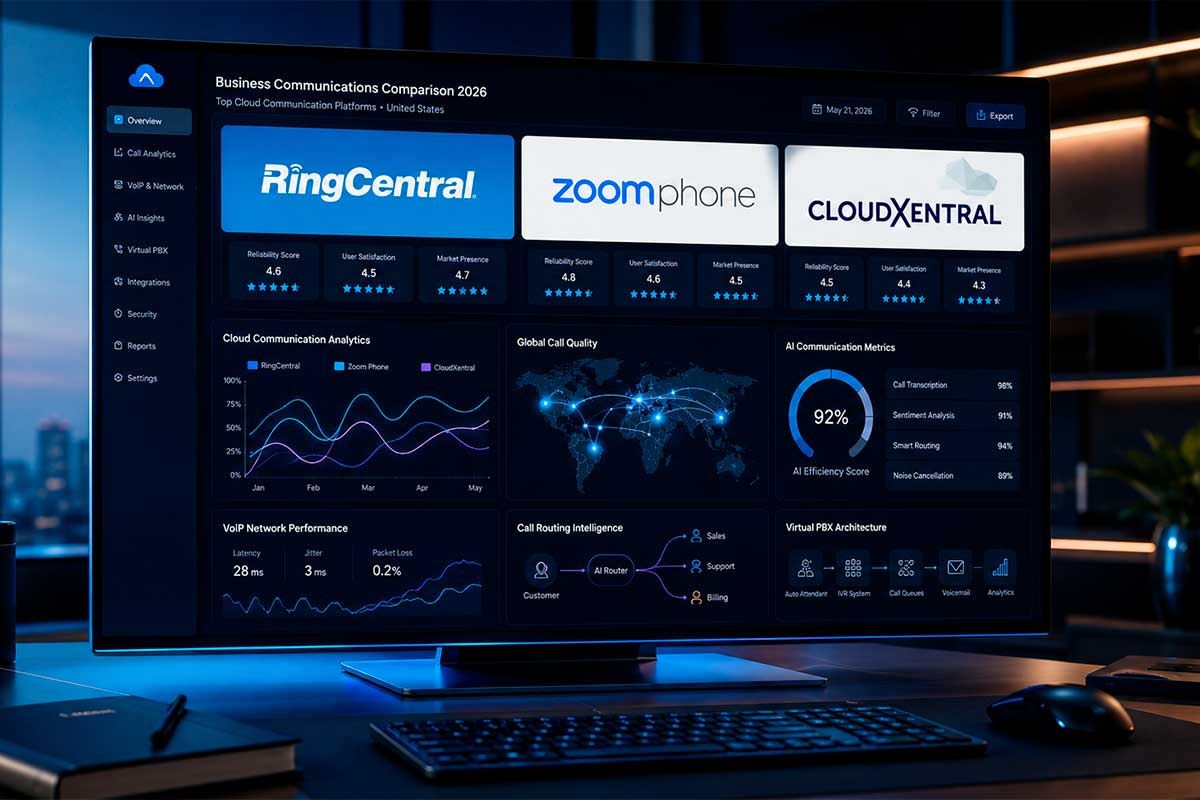
A Virtual PBX Designed for Business Growth
One of the most important differences between legacy phone systems and modern cloud communications is flexibility.
Traditional PBX hardware was built around physical offices. Expanding into another city often required purchasing additional equipment, configuring new phone lines, and investing in on-site infrastructure. Today’s businesses operate very differently. Employees work remotely, companies open satellite offices, and sales teams travel constantly while still needing to maintain one professional business identity.
CloudXentral’s PBX virtual addresses these operational realities by allowing businesses to manage their communications from a centralized cloud platform. New users, extensions, departments, and business numbers can be added without replacing existing infrastructure, making expansion considerably simpler than with traditional PBX environments.
This flexibility also supports business continuity. Employees can answer company calls from IP phones, desktop applications, or mobile devices while maintaining the same professional presence customers expect. Communication remains consistent regardless of where the team is physically located.
Cloud Call Center for Customer-Focused Organizations
Many businesses eventually reach a point where a standard business phone system is no longer sufficient. As customer interactions increase, managing incoming calls efficiently becomes essential for maintaining service quality.
CloudXentral addresses this challenge through its Cloud Call Center, a solution designed for organizations handling larger communication volumes while requiring centralized visibility over customer interactions.
Rather than simply distributing calls between agents, the platform helps businesses organize queues, optimize routing, supervise performance, and improve customer response times. Managers gain greater control over operations while customers experience faster and more consistent service.
This approach is particularly valuable for industries where communication directly influences revenue, including healthcare, insurance, legal services, financial consulting, real estate, and customer support organizations. As call volumes grow, maintaining operational consistency becomes increasingly important, and cloud-based contact center technology provides the flexibility needed to support that growth.
Vocametrics Adds Intelligence to Every Business Conversation
CloudXentral strengthens its communication ecosystem through Vocametrics, an AI-powered conversation analytics platform developed specifically to work with its cloud communication infrastructure.
Rather than functioning as a standalone recording application, Vocametrics transforms every call into structured business intelligence. Conversations are automatically transcribed, analyzed, and evaluated to identify customer sentiment, communication quality, recurring topics, operational risks, and performance trends.
This allows organizations to move beyond traditional quality assurance models based on manually reviewing a small percentage of recorded calls. Supervisors gain broader visibility into customer interactions while managers receive objective information that supports coaching, operational planning, and continuous service improvement.
Instead of asking employees to remember customer conversations or relying exclusively on surveys, decision-makers gain access to measurable communication data that reflects what customers actually experience.
Conclusión
Selecting one of the Top Call Providers in 2026 is no longer about comparing phone features or monthly pricing. Today’s businesses need communication platforms that support growth, improve customer experience, integrate with existing business systems, and generate meaningful operational insights.
As cloud communications continue evolving, providers are increasingly differentiated by their ability to combine reliability, scalability, mobility, and artificial intelligence into a single ecosystem. Organizations that invest in this type of infrastructure are better prepared to support hybrid teams, expand into new markets, and make smarter business decisions based on real communication data.
CloudXentral reflects this evolution by combining Virtual PBX, Cloud Call Center, Click2Call, and AI-powered conversation intelligence into a flexible platform built for modern business communications.
FAQS
Businesses should evaluate far more than pricing or the number of included features. A modern provider should offer reliable cloud infrastructure, strong voice quality, business continuity, scalability, security, CRM integrations, AI capabilities, responsive technical support, and the flexibility to adapt as the company grows. Choosing a provider with these characteristics helps avoid costly migrations as communication needs evolve.
In most business environments, yes. Cloud communication platforms are designed with redundancy, distributed infrastructure, and centralized management that reduce dependence on local hardware. This allows companies to continue operating even when employees work remotely or individual offices experience connectivity or equipment issues.
Artificial intelligence is transforming business communications by moving beyond simple call handling. Modern platforms increasingly provide automatic transcription, conversation intelligence, sentiment analysis, quality monitoring, compliance detection, and operational reporting. These capabilities help managers improve customer service, optimize sales performance, and make decisions using objective communication data.
A modern cloud communication platform should scale as the business expands. Organizations should be able to add users, departments, office locations, phone numbers, and advanced communication features without replacing existing infrastructure. This scalability reduces operational disruption and protects long-term technology investments.
Businesses increasingly depend on multiple communication channels, including voice, websites, CRM platforms, customer support systems, and remote collaboration tools. An integrated ecosystem connects these technologies into a unified environment, improving operational efficiency, customer experience, reporting accuracy, and business visibility across the organization.
SÍGUENOS EN YOUTUBE
Tú podrías estar interesado...
Contact Center Call Abandonment A customer calls because they need …
Click to Call Conversion Businesses invest heavily in SEO, paid …
Contact Center Workforce Forecasting A company can have enough customer …
Virtual PBX Business Continuity Business messaging in the United States …
 ES
ES  EN
EN
2 respuestas