
AI Agent Handoff: Connecting AI and Human Teams in 2026
AI Agent Handoff
AI virtual agents are becoming capable of handling increasingly sophisticated customer conversations. They can answer questions, identify intent, collect information, schedule appointments, route requests, and complete routine interactions without requiring an employee to participate in every call. The real challenge begins when the conversation reaches a point where automation should stop.
A customer may request an exception that falls outside standard policy. A sales prospect may begin negotiating contract conditions. A caller may become increasingly frustrated or describe a situation that requires judgment, empathy, authorization, or specialist knowledge. At that moment, the quality of the experience depends heavily on what happens between the AI system and the person taking over.
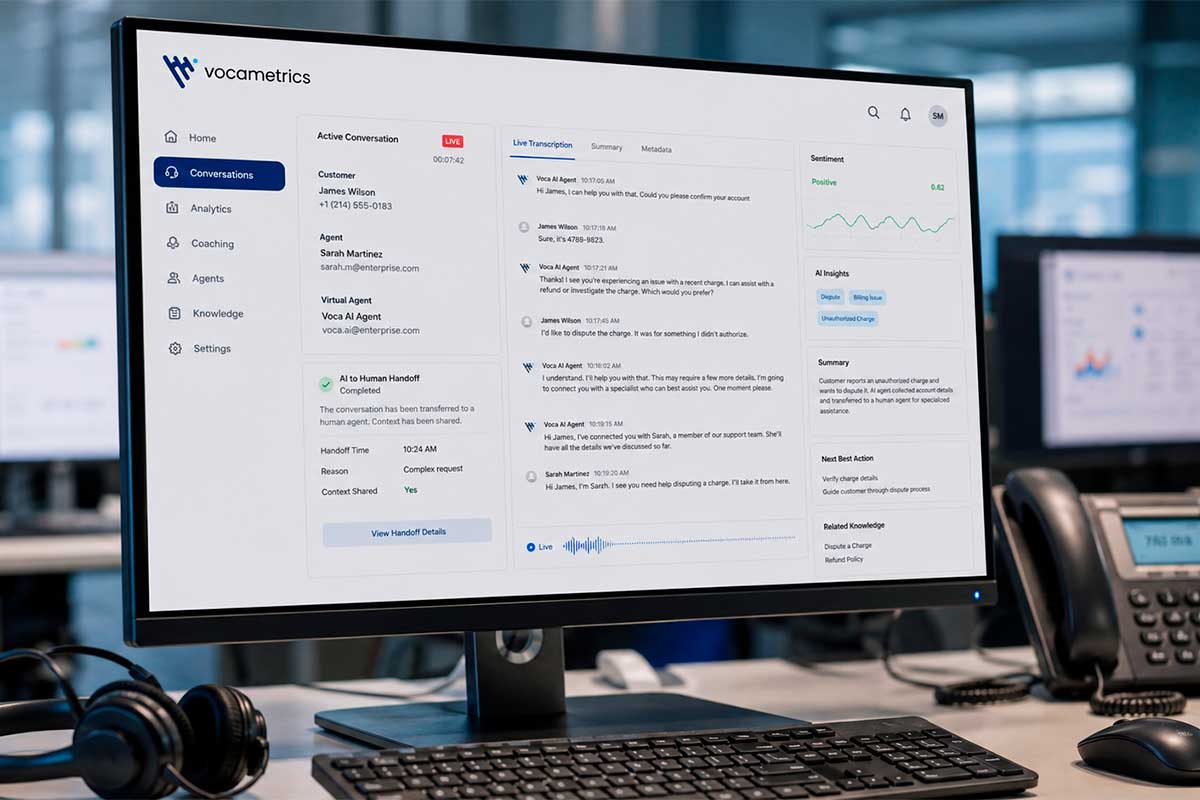
This is where AI Agent Handoff becomes an important part of business communications in 2026. A successful handoff should transfer more than the call itself. It should preserve enough context for the human agent to understand what has already happened, why the conversation was escalated, and what the customer expects next.
What is an AI Agent Handoff?
Un AI Agent Handoff is the transition of a customer interaction from an artificial intelligence agent to a human employee while preserving the relevant information generated during the automated portion of the conversation.
That distinction separates a handoff from a conventional call transfer. A call transfer primarily changes where the communication is routed. A contextual handoff transfers the conversation together with information that helps the receiving employee continue the interaction intelligently.
The objective is continuity. If an AI virtual agent has already identified the customer, recognized the purpose of the call, gathered relevant information and attempted a resolution, the human agent should not need to begin again from zero.
A well-designed handoff can provide the receiving agent with several pieces of useful context:
- The customer’s identity, request and detected intent.
- A concise summary of what has already been discussed or attempted.
- The specific reason the AI determined that human intervention was required.
Those details can turn what would otherwise be an interruption into a genuine continuation of the same customer experience.
Tú podrías estar interesado...
Marcación interna directa permite a las empresas asignar varios números de teléfono a un único sistema PBX, lo que permite a los clientes contactar directamente con empleados o departamentos específicos. Cuando se realiza una llamada a un número DID, la PBX la enruta a la extensión designada sin requerir la intervención de una recepcionista.
Este sistema se integra con tecnologías VoIP y basadas en la nube, ofreciendo funciones avanzadas como desvío de llamadas, correo de voz a correo electrónico y análisis en tiempo real. Las empresas también pueden configurar reglas de enrutamiento de llamadas para garantizar que las consultas de los clientes se dirijan a los equipos adecuados, mejorando la eficiencia general de la respuesta.
Why call transfer and contextual handoff are different
Traditional phone systems have been transferring calls between departments and employees for decades. Routing a caller from one extension to another is therefore not the technological challenge.
The challenge is transferring knowledge.
Imagine a customer spends four minutes speaking with an AI virtual agent about an incorrect charge. During that interaction, the system identifies the account, determines which invoice is involved, confirms that the customer disputes a particular item and recognizes that the requested adjustment requires managerial approval.
A basic transfer sends the voice call to billing.
A contextual AI Agent Handoff can prepare the billing representative to receive a customer whose identity, intent, disputed invoice and reason for escalation are already known. The customer can continue the conversation instead of reconstructing it.
This distinction matters because customers generally evaluate the entire interaction as one experience. They do not care that one portion was handled by AI and another by a person. From their perspective, they are speaking with the same company.

When should an AI virtual agent transfer a customer to a human?
An AI virtual agent should not be designed to retain every conversation for as long as technically possible. The better objective is to automate interactions where automation performs well and recognize the conditions where human judgment produces a better result.
Explicitly asking for a representative is an obvious handoff trigger, but it should not be the only one. Modern systems can consider the type of request, confidence in the detected intent, business rules and signals appearing throughout the conversation.
Three categories are particularly relevant:
- Complexity and exceptions: negotiations, unusual billing situations, policy exceptions or cases that require authorization beyond the virtual agent’s available actions.
- Customer experience signals: repeated misunderstandings, increasing frustration, unsuccessful attempts to resolve the request or language indicating dissatisfaction.
- Business and compliance rules: sensitive situations, regulated processes or defined workflows where the organization requires human review.
Effective escalation therefore depends on knowing the limits of automation before those limits become visible to the customer.

AI Agent Handoff should preserve context, not simply route calls
Context preservation is one of the most important principles behind AI-to-human handoff.
During a normal conversation, information accumulates progressively. The customer explains the problem. The AI asks questions. The caller provides account information. A possible solution is explored. An action may succeed or fail. The emotional tone of the interaction may also change.
If all of that information disappears during the transfer, the organization has technically retained the connection while losing the conversation.
A better architecture treats the interaction as a continuous information flow. The human agent receives enough structured context to understand what has happened before answering the customer. That can include the original intent, relevant customer details, actions already completed, previous answers and a summary of unresolved issues.
This approach becomes increasingly important as AI agents perform more steps independently. The more work an AI completes before escalation, the more damaging it becomes to discard that work at the point of transfer.
How do AI agents transfer context to human agents?
An AI agent can transfer context by converting the conversation into structured information that another system or employee can interpret quickly.
A transcript may provide the complete record, but asking an employee to read several minutes of dialogue while a customer waits is rarely practical. The handoff therefore benefits from summarization and structured conversation intelligence.
A useful handoff package may contain:
- A short conversation summary and the primary reason for contact.
- Actions completed, information collected and unresolved requests.
- Relevant sentiment, escalation signals or other indicators requiring attention.
The objective is not to overwhelm the receiving employee with every data point generated during the call. It is to deliver the information required to make the next decision.
This is where conversation intelligence can complement the AI agent itself. The virtual agent manages the interaction, while analytical systems help structure what occurred so that the information can remain useful after the conversation changes hands.
How Vocametrics can support contextual continuity
Within the CloudXentral communications ecosystem, Vocametrics provides a conversation intelligence layer that can transform business calls into structured information through capabilities such as transcription, summaries, sentiment analysis and operational conversation analysis.
That becomes particularly relevant to AI Agent Handoff because a human representative rarely needs another raw recording when receiving an escalated interaction. What they need is useful context.
A conversation summary can explain the problem quickly. Transcription creates a searchable record of what was said. Sentiment analysis can reveal whether frustration appeared before the escalation. Conversation-level intelligence can provide supervisors and operational teams with a clearer understanding of why particular interactions move from automation to human assistance.
The value of Vocametrics in this scenario is therefore broader than analyzing calls after they finish. Conversation data can help organizations understand the quality of the transition between AI and humans and determine whether their escalation logic actually produces better customer experiences.

AI Agent Handoff and customer frustration
One of the easiest ways to damage confidence in an automated service is to make customers repeat information that the company already collected.
The problem becomes more serious when the transfer follows a difficult interaction. A caller may already have explained an issue several times, attempted troubleshooting steps or expressed dissatisfaction. Asking that person to start again introduces friction at precisely the moment when the organization needs to reduce it.
Sentiment can therefore become a valuable contextual signal during escalation. A transfer involving a calm customer asking for specialist advice is fundamentally different from a transfer involving a customer whose frustration has progressively increased.
The receiving representative does not necessarily need an elaborate emotional profile. A clear indication that the interaction became difficult can be enough to influence how the agent approaches the first seconds of the human conversation.
AI orchestration makes the handoff part of a larger workflow
The growing discussion around AI orchestration in 2026 reflects an important change in how enterprise AI is being designed. Individual agents become more useful when they can interact with communication systems, business applications and people as part of a coordinated workflow.
Un AI Agent Handoff is one of the clearest examples of why that coordination matters.
The AI virtual agent may understand the customer’s initial request. A PBX or Contact Center platform determines where the interaction should go. Business systems may contain account information. Conversation intelligence provides additional context. The human employee eventually makes a judgment or performs an action that automation should not complete independently.
These components should behave as parts of the same customer journey rather than isolated tools.
This is particularly relevant for communications providers such as CloudXentral, where PBX infrastructure, call routing, virtual agents and conversation intelligence can participate within the same operational environment. The quality of AI adoption increasingly depends on how well these systems exchange useful context.
Measuring whether AI-to-human handoffs actually work
Deploying contextual handoffs does not automatically mean that they are effective. Organizations need to evaluate what happens before and after escalation.
One useful metric is repetition. If customers frequently repeat information immediately after transfer, the handoff is probably failing to provide enough context.
Another signal is resolution after escalation. A transfer can appear successful because the customer reached an employee, yet the underlying issue may remain unresolved. Conversation analysis can help determine whether escalation ultimately moved the interaction closer to a satisfactory outcome.
Organizations should also examine which conversations are being escalated. Excessive handoffs may indicate that the virtual agent lacks the information or integrations needed to perform common tasks. Too few escalations can be equally problematic if automation continues handling situations where human judgment would have produced a better result.
Conclusión
The major challenge for enterprise AI in 2026 is becoming less about whether an artificial intelligence system can answer a customer and more about whether the organization can maintain continuity when automation reaches its limits.
AI virtual agents will continue becoming more capable. Human employees will remain necessary for situations involving judgment, exceptions, negotiation, empathy and accountability. The quality of the customer experience will increasingly depend on how intelligently companies connect those two sides.
Un AI Agent Handoff should make that transition almost invisible to the customer. Information should survive the transfer. Previous actions should remain visible. The reason for escalation should be understood. The human representative should enter the conversation prepared rather than starting another one.
CloudXentral’s communications infrastructure creates the environment where virtual agents, PBX capabilities, routing and human teams can work within connected communication workflows. Vocametrics adds another valuable layer by helping transform conversations into structured intelligence that can improve visibility around what occurred before and after escalation.
FAQS
Yes. A well-designed handoff can reduce repeated questions, shorten the time required for a human agent to understand the case and create greater continuity between automated and human service. Its effectiveness still depends on routing logic, the quality of transferred context and how the receiving team uses that information.
AI agents can pass structured information such as the customer’s intent, conversation summary, information collected, actions completed, unresolved issues and escalation reason. Conversation intelligence can also provide additional signals such as sentiment or recurring topics that help the receiving employee understand the situation faster.
A traditional call transfer primarily moves the active communication to another extension, queue or employee. An AI Agent Handoff preserves relevant knowledge from the previous automated interaction so the human representative can continue the conversation with an understanding of what already happened.
A virtual agent should escalate when the request exceeds its authorized capabilities, requires human judgment, involves an exception, shows signs of customer frustration or reaches a situation defined by the company’s business or compliance rules. The decision should depend on context rather than waiting exclusively for the customer to request a person.
SÍGUENOS EN YOUTUBE
Tú podrías estar interesado...
Contact Center Call Abandonment Businesses invest heavily in SEO, paid …
Click to Call Conversion Businesses invest heavily in SEO, paid …
Contact Center Workforce Forecasting A company can have enough customer …
Virtual PBX Business Continuity Business messaging in the United States …
 ES
ES  EN
EN
3 respuestas