
AI contact center process optimization: Uses in 2026
AI contact center process optimization
Contact Centers generate thousands of conversations that contain evidence about customer frustration, process failures, agent performance, recurring problems, resolution quality, and potential business risks. The operational challenge is that much of this information traditionally remains trapped inside recordings that someone must find, listen to, interpret, and classify manually.
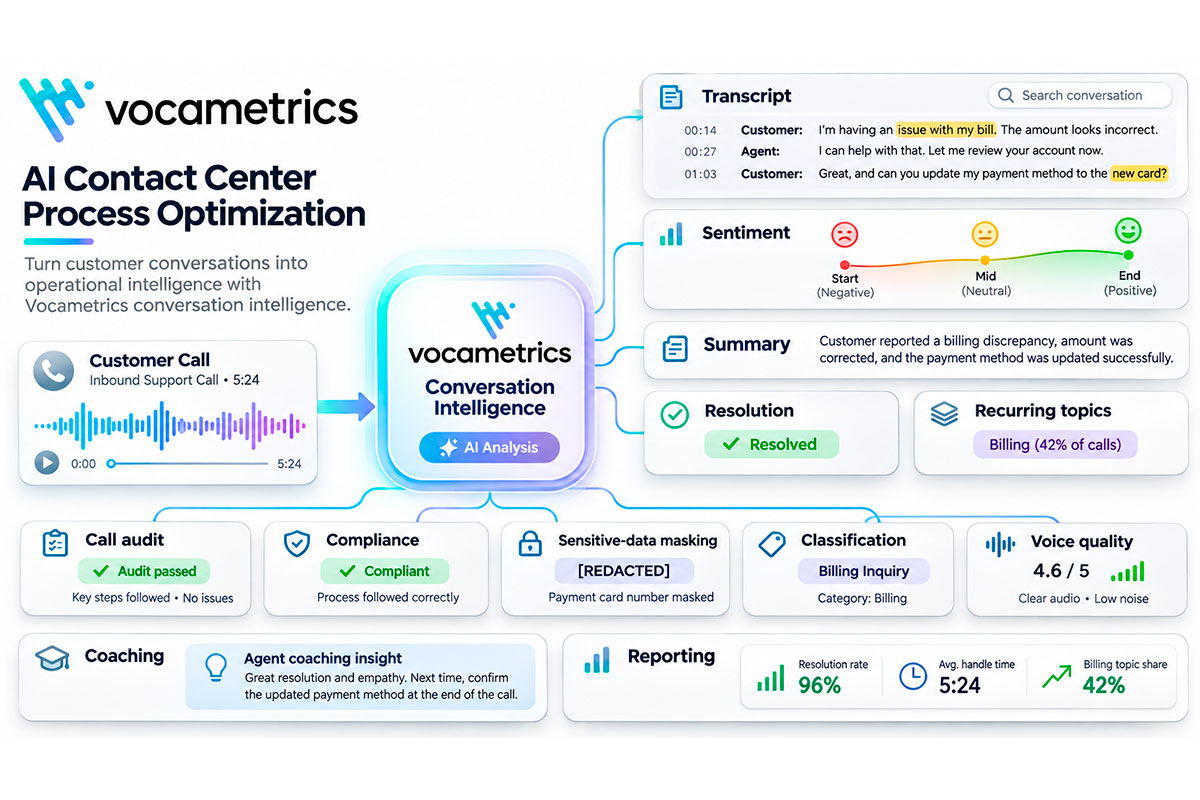
AI Contact Center Process Optimization changes that model by making conversation analysis part of everyday operations. Instead of treating recorded calls as an archive reviewed only when a complaint or audit requires it, AI can transform conversations into transcripts, summaries, sentiment signals, topics, resolution indicators, compliance evidence, and management information.
For organizations evaluating conversation intelligence in 2026, the relevant question is no longer whether AI can analyze calls. The stronger business question is which existing processes become faster, broader, and easier to manage once the information inside those calls becomes immediately accessible.
What is AI contact center process optimization?
AI Contact Center Process Optimization is the use of artificial intelligence to improve operational workflows that depend on understanding customer conversations. It can reduce manual call review, expand the number of interactions evaluated, identify patterns across large volumes, and provide supervisors with structured evidence instead of requiring them to reconstruct events from audio.
The objective is different from simple call analytics. A transcript has limited operational value if nobody uses it to accelerate an investigation. A sentiment score matters less if it cannot help identify conversations that deserve attention. A compliance result becomes more useful when managers can see where a process repeatedly breaks down.
This is where Vocametrics is positioned differently from a basic recording system. Its current platform combines transcription, sentiment analysis, summaries, topic extraction, outcome analysis, call classification, sensitive-data handling, operational reporting, and other analytical capabilities across conversations. Vocametrics states that every call can be transcribed and analyzed automatically rather than relying on a limited manual sample.
Tú podrías estar interesado...
Marcación interna directa permite a las empresas asignar varios números de teléfono a un único sistema PBX, lo que permite a los clientes contactar directamente con empleados o departamentos específicos. Cuando se realiza una llamada a un número DID, la PBX la enruta a la extensión designada sin requerir la intervención de una recepcionista.
Este sistema se integra con tecnologías VoIP y basadas en la nube, ofreciendo funciones avanzadas como desvío de llamadas, correo de voz a correo electrónico y análisis en tiempo real. Las empresas también pueden configurar reglas de enrutamiento de llamadas para garantizar que las consultas de los clientes se dirijan a los equipos adecuados, mejorando la eficiencia general de la respuesta.
How automated call auditing improves quality assurance
Traditional quality assurance frequently depends on supervisors selecting a small number of conversations for review. That creates a practical limitation: the calls reviewed may reveal individual problems, but they may not represent what is happening across an entire team, campaign, shift, or customer segment.
Automated auditing changes the process by applying defined evaluation criteria across a much larger conversation set. Instead of spending most of the QA cycle finding and listening to calls, supervisors can focus their attention on exceptions, recurring deviations, and interactions that deserve deeper investigation.
Examples of elements that can be evaluated include:
Required process steps: whether the expected stages of an operational workflow appear in the conversation.
Mandatory questions or statements: whether agents delivered or requested information required by the business process.
Procedure consistency: whether similar interactions were handled according to the same expected operational standard.
The important improvement is coverage. Vocametrics describes automated evaluation of conversations for quality and compliance shortly after the call ends, allowing QA teams to move beyond isolated monthly samples toward broader operational visibility.

How searchable transcription reduces manual call review
Transcription becomes operationally valuable when teams can search what was said instead of listening to complete recordings. A manager investigating refunds, cancellations, defective products, billing disputes, appointment problems, or complaints can locate relevant conversations based on their content.
Vocametrics currently documents word-level transcription in 25 languages, automatic language detection, speaker separation, timestamps, confidence values, handling of long calls, and custom vocabulary for company-specific terminology. That makes transcription useful for investigation and review rather than merely producing a text version of an audio file.
Multilingual operations benefit from the same principle. When conversations in different languages can be transcribed and translated for review, supervisors are less dependent on finding a reviewer who speaks the original language before they can understand what happened. This can make multilingual quality, escalation, and complaint investigation considerably easier to organize.

How sentiment analysis improves customer experience monitoring
Customer experience teams often depend on surveys, complaint volumes, escalation reports, or manual call reviews to discover where frustration is increasing. Sentiment analysis introduces another source: the emotional behavior that appears directly within the customer conversation.
Vocametrics analyzes sentiment separately for customer and agent and can follow changes throughout a call rather than reducing the conversation to a single final label. Its product information also describes detection of emotions such as satisfaction, anger, confusion, gratitude, anxiety, and neutrality, while identifying the point where sentiment changed.
For operations teams, the benefit is prioritization. A manager can investigate whether frustration repeatedly appears during billing explanations, transfers, cancellations, appointment scheduling, or another process. Sentiment becomes useful when it helps point the team toward where customer experience needs investigation, rather than becoming another isolated score.
How AI helps verify whether customer issues were resolved
A completed call and a resolved customer problem are different outcomes. The customer may hang up because an agent solved the issue, because the conversation reached a temporary next step, or simply because continuing the call was no longer useful.
Resolution analysis can help Contact Centers examine that difference at scale. Vocametrics explicitly evaluates whether a call appears to have ended with the customer’s issue resolved and includes resolution information within its structured summaries.
This improves operational review because teams can investigate calls that technically completed but show indications of incomplete resolution. When combined with other internal data such as repeat contact or CRM case status, resolution analysis can help managers identify where a process appears successful from a telephony perspective but fails from the customer’s perspective.
How automated process audits support compliance
Many Contact Center processes contain mandatory elements. A financial service interaction may require identity verification. An insurance workflow can require specific questions. A regulated sales process may require disclosures. An internal procedure may depend on completing several steps in a particular sequence.
Manually checking whether those elements appear across large call volumes is difficult to scale. Automated conversation analysis makes it possible to identify calls where the expected process appears incomplete and direct human reviewers toward the interactions most likely to require attention.
Common process deviations can include:
Missing steps: a required part of the workflow does not appear in the analyzed conversation.
Incorrect sequence: expected elements occur, but the interaction does not follow the process designed by the organization.
Incomplete verification: the conversation finishes without sufficient evidence that an expected validation step was completed.
Vocametrics also documents sensitive-data detection and masking for information such as credit card details, phone numbers, emails, banking information, dates of birth, and identification documents, together with audit trails and role-based controls. These functions can support internal compliance processes, although the technology itself should not be treated as an automatic guarantee of regulatory compliance.
How recurring conversation topics reveal operational problems
Individual complaints can be anomalies. Repeated complaints about the same issue may indicate something larger: a confusing policy, defective product, billing problem, support gap, or process that consistently creates customer effort.
Conversation intelligence helps teams move from individual incidents toward patterns. Vocametrics extracts topics and can organize recurring conversation themes such as billing, technical support, appointments, cancellations, and complaints. Its current product documentation also describes trend analysis designed to show which topics are increasing compared with previous periods.
The distinction between pattern detection and root-cause analysis is important. AI can reveal that a problem is appearing repeatedly and surface the relevant conversations, but operations teams still need to investigate why it exists. That combination is useful because human analysis starts with a defined body of evidence instead of searching blindly through recordings.
How conversation intelligence improves coaching preparation
Agent coaching often begins long before the actual coaching session. Supervisors need to identify useful calls, listen to them, find specific moments, understand the context, and determine which behavior is worth discussing.
Structured conversation analysis can reduce that preparation work. Searchable transcripts, summaries, sentiment changes, topics, outcomes, and process evaluations make it easier to locate interactions that illustrate a particular coaching opportunity.
Vocametrics also synchronizes transcripts with recordings, allowing reviewers to navigate from words in the transcript to the corresponding moment in the audio. That can make coaching more specific because supervisors can work with evidence from exact moments instead of relying on broad impressions of an entire call.

How sensitive data detection supports conversation review
Call recordings and transcripts can contain information that requires careful handling. Depending on the industry, customers may mention account numbers, identification details, payment information, health information, addresses, or other personal data during routine conversations.
Vocametrics states that detected sensitive values can be masked in transcripts rather than stored in their original form. The platform also documents role-based access, audit trails, and the ability to preserve speaker attribution after masking.
This changes the review process because conversation intelligence does not need to ignore sensitive information management. Quality, compliance, and operations teams can incorporate privacy controls into the way analyzed conversations are accessed, while each organization remains responsible for determining the legal, regulatory, and internal requirements that apply to its use case.
How AI reporting improves Contact Center decisions
Traditional Contact Center reporting is strong at describing telecommunications activity: call volume, waiting time, transfers, peak periods, and agent activity. Conversation intelligence adds another layer by describing what customers were discussing and what happened inside those interactions.
Vocametrics currently describes operational and business reporting that includes sentiment, wait experience, compliance, churn risk, product intelligence, topic trends, resolution information, and period-over-period comparisons. Its Executive Summary is designed to surface significant changes without requiring managers to inspect multiple reports individually.
The same information can serve different levels of the organization:
Supervisors: investigate specific conversations, quality issues, agent behavior, and process deviations.
Operations managers: identify recurring patterns affecting customer experience, resolution, workflow consistency, or call handling.
Business leaders: observe broader trends related to customers, products, services, compliance exposure, or retention risk.
The value of reporting increases when the organization can trace a management-level trend back to the conversations that created it. A rise in billing complaints becomes more actionable when managers can identify representative calls, examine what customers said, and determine whether the pattern originates from communication, policy, product, or process.
How call classification improves operational visibility
A Contact Center receives many call events that are not equivalent to completed customer conversations. Some callers reach voicemail, abandon while waiting, interact only with an IVR, or never receive an answer.
Vocametrics distinguishes between real conversations, voicemail, abandoned calls, calls abandoned during waiting, IVR-only interactions, and unanswered calls. It also documents a consolidated timeline covering ringing, answer, holds, transfers, and hang-up events.
This helps operations teams avoid analyzing every call record as though it represented the same customer experience. A long queue abandonment requires a different operational response from a conversation where an agent answered, transferred the caller, and ultimately resolved the issue.
How voice quality can be connected with customer experience
Sometimes the problem inside a call is not what the agent said. Poor audio quality, packet loss, latency, jitter, or other technical issues can make a correct interaction frustrating for the customer.
Vocametrics currently documents voice-quality analysis based on metrics such as MOS, jitter, packet loss, latency, and bitrate, with the ability to correlate technical call quality with sentiment.
That connection can help teams distinguish conversational problems from technical communication problems. If negative sentiment repeatedly appears on calls with degraded voice quality, operations teams gain a different investigation path than they would from reviewing the agent’s language alone.
FAQS
Sentiment analysis helps teams understand how customer emotion evolves during interactions and identify conversations associated with frustration, satisfaction, confusion, or other emotional states. Its operational value increases when sentiment is interpreted alongside the subject, process, resolution, and other context from the call.
Automated transcription makes the spoken content of calls searchable. Supervisors can locate conversations about specific products, complaints, cancellations, billing issues, or other subjects without listening to complete recordings before determining whether they are relevant.
AI can evaluate conversations against criteria defined by the business and identify interactions where expected steps, statements, questions, or procedures appear to be missing. Human reviewers can then focus on exceptions and complex cases instead of selecting every call manually.
AI can improve processes where teams traditionally spend significant time listening to recordings, manually classifying calls, checking adherence, identifying recurring problems, or preparing reports. The objective is to convert conversational data into structured information that accelerates human analysis and decision-making.
AI Contact Center Process Optimization is the use of artificial intelligence to improve workflows that depend on understanding customer conversations. It can support processes such as automated auditing, transcription review, sentiment monitoring, resolution analysis, compliance verification, coaching preparation, trend detection, and operational reporting.
SÍGUENOS EN YOUTUBE
Tú podrías estar interesado...
AI contact center process optimization Contact Centers generate thousands of …
Call Sentiment Outcome Analysis A customer can sound frustrated throughout …
Law firm client intake PBX A potential client may spend …
AI Voice of Customer Analysis Companies spend significant resources on …
 ES
 EN