
Contact Center Workforce Forecasting: Agent Scheduling in 2026
Contact Center Workforce Forecasting
A company can have enough customer service agents to handle its average daily call volume and still experience serious service problems during peak hours. Customers may wait several minutes to speak with a representative in the morning, while the same contact center has available agents during the afternoon. The problem frequently comes from scheduling decisions that fail to reflect how customer demand changes throughout the day.
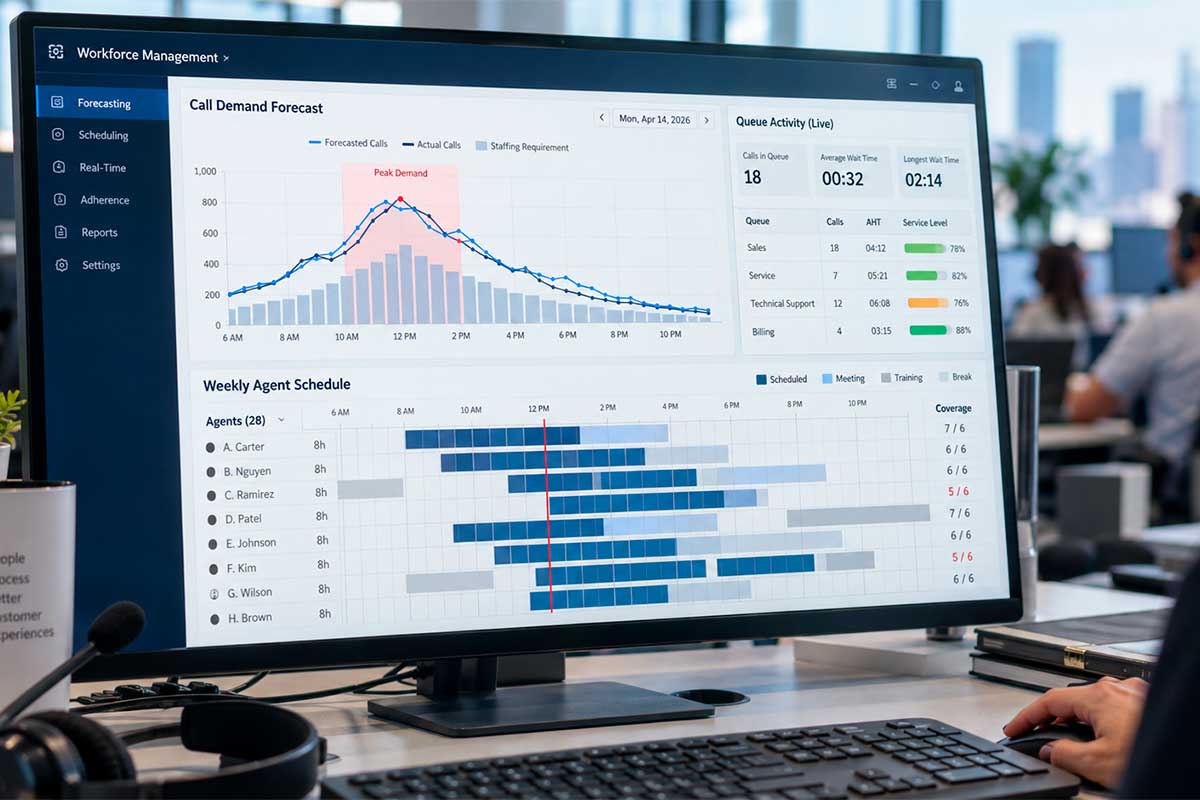
In 2026, Contact Center Workforce Forecasting is becoming increasingly important for businesses that need to balance customer expectations, employee availability, and operating costs. Instead of building schedules around fixed assumptions or daily averages, organizations can examine historical traffic, interaction duration, seasonal patterns, and service targets to estimate how many agents they need during specific periods.
According to Peopleware’s State of WFM Report 2026, developed in partnership with Call Centre Helper, 36% of surveyed organizations reported difficulties managing unexpected demand spikes.
What is Contact Center Workforce Forecasting?
Contact Center Workforce Forecasting is the process of estimating future customer interaction volumes and the resources required to manage them while maintaining established service standards. It combines historical call records, average handling times, traffic patterns, business events, and operational targets to anticipate how demand may change across different periods.
A forecasting model should distinguish between the number of calls received and the workload those calls generate. For example, two departments may receive the same number of daily interactions, but one may require twice as much handling time because its agents manage technical support requests rather than straightforward appointment confirmations. Using call volume alone would underestimate the staffing requirements of the more complex operation.
The information generated through forecasting provides a foundation for workforce management, including capacity planning and scheduling. Specialized WFM systems can combine predicted interaction volumes with handling times, service-level targets, agent availability, and other operational variables to calculate staffing requirements for individual intervals and skill groups.
Tú podrías estar interesado...
Marcación interna directa permite a las empresas asignar varios números de teléfono a un único sistema PBX, lo que permite a los clientes contactar directamente con empleados o departamentos específicos. Cuando se realiza una llamada a un número DID, la PBX la enruta a la extensión designada sin requerir la intervención de una recepcionista.
Este sistema se integra con tecnologías VoIP y basadas en la nube, ofreciendo funciones avanzadas como desvío de llamadas, correo de voz a correo electrónico y análisis en tiempo real. Las empresas también pueden configurar reglas de enrutamiento de llamadas para garantizar que las consultas de los clientes se dirijan a los equipos adecuados, mejorando la eficiencia general de la respuesta.
Why average call volume is not enough to plan agent schedules
Daily averages can conceal substantial variations in customer demand. A contact center receiving 800 calls during an eight-hour business day might initially assume that it needs enough agents to manage approximately 100 calls per hour. Actual traffic rarely follows such a consistent distribution, particularly when customers respond to marketing campaigns, billing notifications, service interruptions, or recurring business events.
A U.S. insurance company, for example, may receive a disproportionate number of calls early on Monday mornings, while a healthcare provider may experience higher appointment-related traffic at particular times. If both organizations distribute their agents evenly throughout the day, they could face long waiting times during predictable demand peaks and unnecessary staffing capacity during quieter periods.
Analyzing demand in shorter intervals helps managers identify the difference between total workload and the timing of that workload. Peopleware describes short-term workforce forecasting as an activity commonly performed using 15- or 30-minute intervals, allowing organizations to plan resources around more precise variations in customer activity.

How to predict peak call hours and seasonal demand
Historical call records are an important starting point for identifying recurring demand patterns. Workforce planners can examine previous weeks or months to determine which hours consistently generate higher volumes, how traffic changes between weekdays, and whether particular business events influence the number or duration of customer interactions.
Reliable forecasting also requires understanding which historical patterns may change. A retailer preparing for a promotional campaign should consider previous campaign results rather than assuming normal traffic conditions will continue. A financial services company may need to account for billing cycles, while a technical support operation should examine the potential impact of product launches, system updates, and known service incidents.
Three categories of information are particularly useful when preparing a call volume forecast:
Historical traffic: Call volumes, arrival patterns, average handling times, abandoned interactions, and recurring fluctuations across different intervals.
Business-related variables: Marketing campaigns, billing schedules, holidays, seasonal activity, product launches, and other events that may influence customer demand.
Operational conditions: Service-level objectives, agent skills, availability, planned training, and other factors that influence how much work the team can handle.
Workforce forecasting vs agent scheduling: What is the difference?
Workforce forecasting, capacity planning, and agent scheduling are closely related processes, but each addresses a different operational question. Forecasting estimates the workload an organization expects to receive, capacity planning determines the resources required to handle that workload, and scheduling assigns available employees to the periods when their skills and working hours are needed.
Consider a contact center that correctly predicts increased demand every Monday between 9:00 a.m. and 11:00 a.m. If the organization schedules most of its experienced agents to begin working at noon, the forecast has provided useful information without producing the intended operational result. Staffing decisions must account for the predicted arrival of calls and the actual availability of employees qualified to handle them.
The distinction also affects longer-term management decisions. Short-term scheduling can redistribute existing employees across shifts, while capacity planning may reveal that an organization needs additional hiring, training, or changes to its operating hours.
How to calculate staffing requirements for a contact center
Estimating how many agents a business needs requires more than dividing its expected call volume by the number of employees. A staffing calculation must consider how long interactions take, the service level the organization wants to achieve, the distribution of incoming calls, and the proportion of scheduled time employees will actually be available to handle customers.
An organization forecasting 120 calls during a particular hour, with an Average Handle Time (AHT) of five minutes, expects approximately 600 minutes of customer-handling work. That represents ten hours of workload arriving within one hour, but scheduling exactly ten agents would leave no capacity to absorb uneven arrivals, breaks, or periods when multiple customers call simultaneously.
Specialized workforce planning tools commonly use queueing models, simulation, or methods such as Erlang C to estimate staffing requirements against service-level objectives.

The operational metrics that influence staffing decisions
Workforce managers need to understand how individual metrics affect the resources required to serve customers. A lower average handling time can reduce workload when interaction volumes remain stable, while a more demanding service-level target may require additional agents to keep waiting times within acceptable limits.
The following metrics provide a foundation for evaluating staffing requirements:
Average Handle Time (AHT): The average time required to manage an interaction, including talk time, applicable hold time, and after-call work.
Service Level and Average Speed of Answer (ASA): Measures that help organizations evaluate how quickly customers are answered against their established service objectives.
Shrinkage and occupancy: Indicators of employee availability and the proportion of working time agents spend handling customer interactions rather than waiting for new contacts.
These measurements must be interpreted together because improving one metric can influence another. Increasing agent occupancy excessively may appear efficient from a staffing perspective but leave the organization with insufficient capacity to absorb unexpected demand.
How contact center infrastructure supports workforce planning
Accurate forecasting depends on having reliable information about how customers contact the business and how those interactions move through its communication infrastructure. Call records, queue activity, routing configurations, and agent availability help organizations understand where demand originates and which resources are involved in handling it.
CloudXentral’s Cloud Call Center provides communication capabilities such as call routing, call queues, centralized management, and operational visibility, giving businesses a structured environment for organizing customer interactions. These functions support the operational side of workforce planning by helping managers manage incoming traffic and distribute calls across their teams.
For businesses operating across multiple locations, centralized call management can be particularly useful. A company with service representatives in Florida, Texas, and California may need to coordinate different schedules, time zones, and call distribution rules. The communication platform manages the routing of interactions, while the organization’s workforce planning process determines when and where agents should be available.
How intraday management helps contact centers respond to unexpected demand
Even carefully prepared forecasts cannot anticipate every operational event. An unexpected product failure, service disruption, promotional response, or sudden increase in customer inquiries can produce significantly more traffic than the organization expected during a particular shift. Intraday management addresses this difference between forecasted and actual demand by adjusting operational decisions while the workday is underway.
Imagine a support center that normally receives 60 calls per hour but suddenly experiences a substantial increase following a regional service interruption. Managers need to identify the change, assess the available workforce, determine whether other qualified agents can assist, and decide if scheduled activities should be temporarily reorganized. Their response should consider both the immediate waiting queue and the impact of moving employees away from other responsibilities.
Operational visibility is valuable in these situations because staffing adjustments need to reflect what is actually happening. CloudXentral’s call queue and routing capabilities can help supervisors organize incoming communications and distribute interactions according to their configured workflows.

How to measure Contact Center Workforce Forecasting accuracy
A forecast becomes more useful when an organization regularly compares its estimates with actual traffic. Forecast accuracy measures how closely predicted interaction volumes and handling times match what occurred, helping workforce managers identify recurring errors and improve subsequent planning cycles.
Suppose a contact center repeatedly underestimates the number of calls received between 8:00 a.m. and 9:00 a.m. on Mondays. Analyzing that variance may reveal an outdated historical pattern, a change in customer behavior, or a recurring business event missing from the forecasting model. Correcting the underlying cause can improve staffing decisions without automatically requiring the company to increase its total workforce.
NICE recommends evaluating forecast accuracy alongside other workforce variables because differences between expected and actual demand can affect scheduling efficiency and service performance. Comparing forecasts by interval and skill group is particularly useful for organizations where employees handle different types of customer requests.
Turning forecast accuracy into operational improvements
Managers should avoid evaluating forecasting performance exclusively through a single company-wide percentage. A relatively accurate weekly forecast may conceal substantial errors during the busiest intervals, when staffing shortages are most likely to affect customers.
A practical evaluation process should examine three areas:
Volume variance: Compare the number of predicted and actual interactions across relevant periods, queues, and agent skill groups.
Handling-time variance: Identify differences between expected and actual AHT, particularly when new processes or more complex customer requests change the workload.
Operational impact: Review whether forecast errors coincided with longer waiting times, missed service-level targets, excessive occupancy, or unnecessary staffing capacity.
The results should inform future staffing plans and help managers determine whether the problem comes from inaccurate forecasts, inefficient schedules, unexpected absenteeism, or another operational factor.
Conclusión
Effective workforce forecasting starts with understanding when customers contact the business, how much work those interactions generate, and what resources the organization needs to meet its service objectives. Companies that analyze these variables at the appropriate level can identify predictable demand patterns, make more informed scheduling decisions, and respond more effectively when actual traffic differs from expectations.
A structured contact center environment helps organizations manage the communication side of those decisions. CloudXentral provides call routing, queue management, and centralized administration capabilities that businesses can use to organize customer interactions across departments and locations. Its communications infrastructure can form part of a broader strategy that combines operational data, workforce planning, and appropriately scheduled teams.
If your organization experiences recurring peak-hour congestion, uneven agent workloads, or difficulty coordinating teams across locations, consider reviewing how your current communication infrastructure supports call distribution and operational visibility.
FAQS
Companies can reduce peak-hour understaffing by analyzing historical traffic at shorter intervals, identifying recurring periods of high demand, and aligning employee schedules with those patterns. Regular forecast reviews and intraday adjustments help managers respond when actual call volumes exceed expectations or staffing availability changes unexpectedly.
Workforce forecasting estimates future demand and the resources required to manage it, while workforce scheduling assigns employees to specific shifts according to those requirements. Capacity planning connects the two processes by translating predicted workloads into staffing needs while accounting for service objectives, employee availability, and operational constraints.
The number of required agents depends on forecasted interaction volume, average handling time, service-level targets, expected occupancy, shrinkage, and the skills needed to handle specific requests. Workforce planning models can use queueing calculations or simulation to estimate the number of agents necessary during each interval rather than relying on a fixed daily staffing ratio.
Contact centers predict call volume by examining historical interaction records, identifying recurring patterns, and incorporating events that may influence future demand. Forecasting is often performed in 15- or 30-minute intervals to capture traffic variations that daily averages may overlook. Seasonal changes, marketing campaigns, holidays, and service-related events can also influence the forecast.
SÍGUENOS EN YOUTUBE
Tú podrías estar interesado...
Contact Center Call Abandonment A customer calls because they need …
Click to Call Conversion Businesses invest heavily in SEO, paid …
Contact Center Workforce Forecasting A company can have enough customer …
Virtual PBX Business Continuity Business messaging in the United States …
 ES
ES  EN
EN
2 respuestas