
Contact Center Call Abandonment: Reduce Lost Calls in 2026 – Copy
Contact Center Call Abandonment
A customer calls because they need support, want to make a purchase, have a billing question, or need to speak with someone before making a decision. The business has already earned enough trust or generated enough demand to receive that call, yet the opportunity can disappear before an agent ever speaks with the caller. When people enter a queue and hang up before being served, the problem reaches beyond customer service and begins affecting revenue, retention, and operational efficiency.
Contact Center Call Abandonment measures this critical point in the customer journey. It helps businesses understand how many inbound interactions end before reaching an agent and encourages a deeper question: what happened between the moment the call entered the system and the moment the customer decided waiting was no longer worthwhile?
The distinction matters in 2026 because voice remains an important customer channel. Natterbox’s 2026 contact center benchmark analyzed 58.2 million calls and found that total call volume increased 16.1% year over year, while average queue ringing time declined 12% and connection rates improved by 8.1 percentage points. The findings reinforce that routing and queue performance still have measurable consequences even as businesses add digital and AI-based channels.
What is Contact Center Call Abandonment?
Contact Center Call Abandonment occurs when an inbound caller disconnects before reaching an available agent. Depending on the platform and reporting rules, organizations may exclude extremely short calls because they can represent accidental dialing or callers who disconnect before genuinely entering the service journey.
NICE defines abandonment rate as the percentage of inbound contacts terminated by the customer before connection with an agent. A common calculation divides abandoned contacts by total contacts offered and multiplies the result by 100, although businesses need to understand how their own platform treats short abandons, IVR exits, and other call outcomes before comparing results. NiCE
Abandonment should therefore be interpreted as an operational signal rather than a standalone score. A rising percentage can indicate long waits, ineffective routing, insufficient capacity, an overloaded queue, or a customer journey that creates too much effort before the caller reaches someone who can help.
You might be interested...
Direct Inward Dialing enables companies to allocate multiple phone numbers to a single PBX system, allowing customers to contact specific employees or departments directly. When a call is made to a DID number, the PBX routes it to the designated extension without requiring intervention from a receptionist.
This system integrates with cloud-based and VoIP technologies, offering advanced features such as call forwarding, voicemail-to-email, and real-time analytics. Businesses can also configure call routing rules to ensure that customer inquiries are directed to the appropriate teams, improving overall response efficiency.
Abandoned calls, missed calls, and unanswered calls are different problems
These terms are often grouped together, but they can describe different stages of failure. An abandoned call generally involves a caller who entered the service process and disconnected before reaching an agent, while a missed call can describe an interaction that reached a destination but was not answered. “Unanswered call” may have a broader meaning depending on the telephony platform and reporting configuration.
Understanding those definitions matters before managers begin comparing percentages across teams or providers. A company that includes five-second accidental calls in its abandonment calculation will produce a different result from an operation that removes short abandons, even if the real customer experience is similar.
The operational question should therefore be more precise than “How many calls did we lose?” Managers need to determine where each call ended, how long the caller had already waited, which queue was involved, and whether another routing decision could have produced a different result.

Why customers abandon calls before reaching an agent
Waiting time is one of the strongest contributors to abandonment, but it is rarely the complete explanation. NICE notes a direct relationship between queue time and abandonment: as waiting increases, customers become more likely to end the interaction before an agent becomes available. NiCE
Three areas deserve particular investigation when abandonment begins increasing:
- Long queue times: callers may decide that continuing to wait is not worth the time required, particularly when their issue is urgent or they have alternative providers.
- Poor routing: interactions can enter an overloaded or inappropriate queue even while qualified agents are available elsewhere in the operation.
- Limited queue visibility: callers who do not know how long they will wait or whether another option exists may experience the queue as indefinite.
Several of these problems can occur during the same interaction. A customer might spend too long navigating an IVR, enter the wrong queue, wait another few minutes, and eventually disconnect. Measuring only the final abandonment hides everything that happened before that decision.
Call abandonment rate: What should businesses actually measure?
A company-wide monthly abandonment rate can be useful for trend reporting, but it can conceal the periods and queues where the real operational problem exists. A business may report an acceptable overall average while experiencing severe abandonment between 9:00 and 10:00 a.m., during billing cycles, after marketing campaigns, or inside one overloaded support queue.
NICE notes that abandonment thresholds vary by sector and channel, while its current guidance indicates that voice abandonment above roughly 5% to 8% generally deserves investigation. That figure should not be treated as a universal target because caller expectations, business urgency, measurement rules, and queue design differ considerably between industries. NiCE
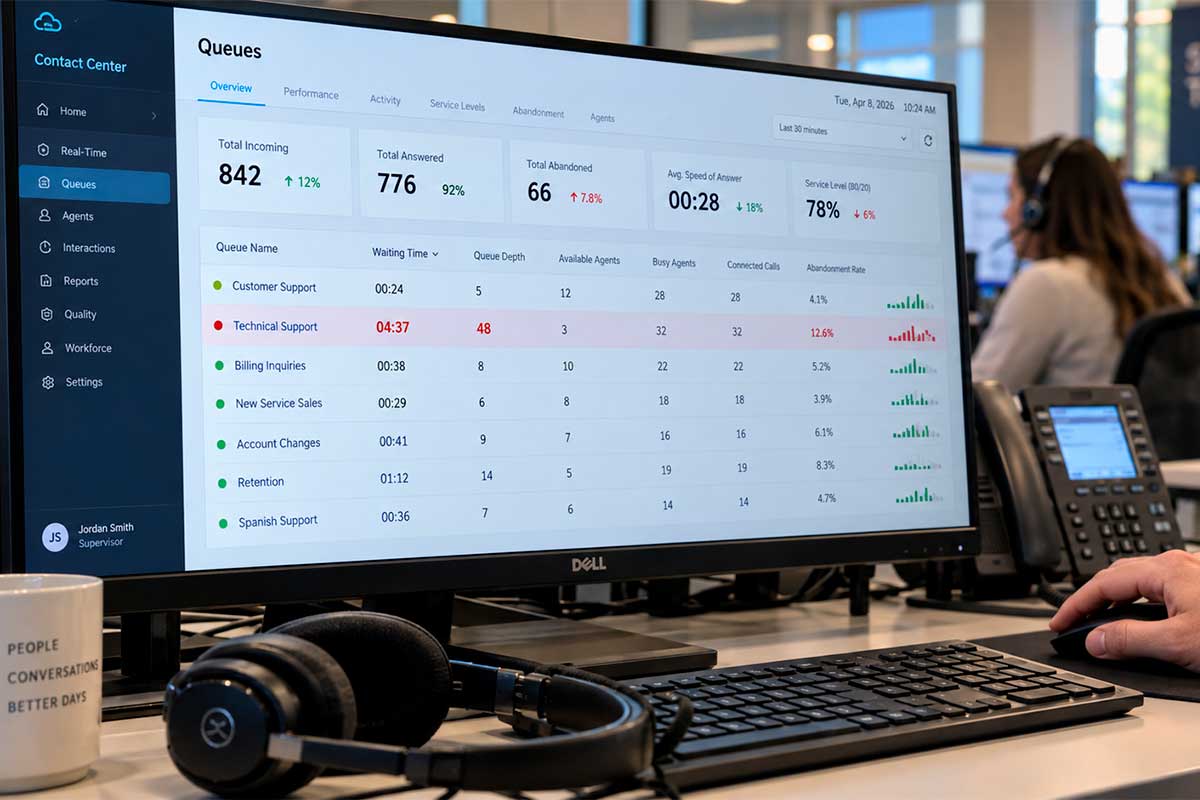
A better analysis connects abandonment with Average Speed of Answer, queue depth, call arrival patterns, service level, staffing availability, and the specific destination where callers leave. The goal is to understand whether customers are abandoning because demand temporarily exceeds capacity or because the call journey itself is inefficient.
Long wait times vs. poor routing: Where is the real problem?
Long queues often lead management teams to conclude that they need more agents. Sometimes that is correct, especially during predictable demand peaks, but staffing cannot compensate for every routing problem. An organization may have employees available while callers remain trapped in another queue that has been configured around the wrong skills, department, schedule, or distribution logic.
Natterbox’s 2026 benchmark provides a useful example of why the routing layer matters. Across its dataset, the time callers spent being routed before reaching a queue fell from 5.15 minutes in 2024 to 2.37 minutes in 2025, while the connection rate increased from 52.5% to 60.6%. The study attributes much of that improvement to better routing architecture rather than simply asking agents to work faster. Natterbox
This is where CloudXentral’s Cloud Call Center has a natural role. CloudXentral documentation shows that incoming queue calls can be automatically distributed among available agents and that calls can be transferred between queues, agents, or other destinations, giving businesses infrastructure for structuring how inbound traffic moves through the operation.

How queue management can reduce abandoned calls
A contact center queue is more than a virtual waiting room. It determines which interactions wait together, which agents can receive them, how traffic is prioritized, and what happens when the preferred destination cannot immediately answer.
NICE describes queues as the operational backbone behind metrics such as Average Speed of Answer, service level, queue depth, and abandonment rate. When queue structures reflect customer intent and agent capabilities, callers have a better chance of reaching the right resource without unnecessary transfers or extended waiting.
CloudXentral’s documentation shows that its agent environment registers users into assigned call center queues and automatically distributes new incoming calls among available agents. Those capabilities allow businesses to structure traffic around the teams responsible for serving it, while supervisors still need to review demand, schedules, routing rules, and queue performance as conditions change.
Virtual callback vs. waiting on hold
When a queue becomes saturated, keeping every caller physically connected until an agent becomes available is not the only possible operating model. Virtual queuing or callback strategies allow some contact centers to release the customer from active hold and contact them later according to the rules of the system.
Three approaches illustrate how businesses can manage excessive waiting:
- Continue waiting: the caller stays connected and maintains the traditional hold experience until an agent becomes available.
- Virtual callback: the caller exits active hold and receives a later call according to the contact center’s callback workflow.
- Alternative channel: the business directs suitable requests toward another channel when immediate voice assistance is unnecessary.
NICE identifies queue callback as an effective approach to reducing abandonment because customers are not required to remain physically on hold for the entire waiting period. A callback strategy still requires adequate capacity later; it changes the waiting experience rather than eliminating the underlying workload.
How estimated wait time influences caller behavior
Uncertainty can make a queue feel longer than the actual elapsed time. A customer who knows that the expected wait is approximately four minutes can decide whether that commitment is acceptable, while a caller hearing repeated hold music without any useful information has little basis for estimating when service will begin.
Estimated wait times, queue-position messages, and other forms of transparency can give callers more control over the experience when the system supports them. Accuracy matters because repeatedly promising a shorter wait than the operation can deliver may damage trust instead of improving it.
Businesses should therefore treat queue messaging as part of operational design rather than decorative audio. Information given to callers should reflect actual system conditions and help them decide whether remaining in the queue, requesting another option, or returning later makes the most sense.

Reducing Contact Center Call Abandonment in 2026
The 2026 contact center environment makes queue performance especially important because voice remains a high-value channel for complicated, urgent, and commercially meaningful interactions. Natterbox’s recent benchmark found increasing overall call volumes alongside improved connection rates and lower routing and queue times, demonstrating that companies are still investing in making voice interactions more efficient.
Businesses trying to reduce Contact Center Call Abandonment should focus on the complete pre-agent journey rather than treating abandonment as an isolated KPI. Routing, queue structure, agent availability, waiting experience, operating schedules, and the value of each interaction influence whether a caller remains long enough to reach a person.
A well-managed contact center cannot guarantee that every customer will wait indefinitely, nor should that be the objective. The stronger goal is to remove avoidable friction and make sure callers are not leaving because the company’s own communication architecture placed unnecessary barriers between customer intent and the employee capable of helping them.
FAQS
Contact Center Call Abandonment occurs when a caller disconnects before reaching an available agent. Businesses typically track it as the percentage of offered inbound interactions that are abandoned, although the exact calculation may exclude extremely short calls depending on the organization’s reporting rules.
There is no universal percentage that applies equally to every industry or contact center. NICE currently notes that voice abandonment above roughly 5% to 8% generally deserves investigation, but urgency, customer expectations, service type, queue design, and measurement methodology should influence how a business establishes its own target.
Customers commonly abandon because wait times become too long, routing creates unnecessary delays, the caller enters an inappropriate queue, or the waiting experience provides too little information. Demand spikes and insufficient staffing can also increase the likelihood that callers disconnect before an agent becomes available.
An abandoned call generally ends because the caller disconnects before reaching an agent, while a missed call often describes an interaction that reached a destination but was not answered. Definitions can vary between telephony platforms, so businesses should verify their reporting logic before comparing the two metrics.
FOLLOW US IN YOUTUBE
You might be interested...
Contact Center Call Abandonment A customer calls because they need …
Click to Call Conversion Businesses invest heavily in SEO, paid …
Contact Center Workforce Forecasting A company can have enough customer …
Virtual PBX Business Continuity Business messaging in the United States …
 EN
 ES