
Virtual PBX Business Continuity: Keep Calls Running in 2026
Virtual PBX Business Continuity
Business messaging in the United States is entering a new stage. For years, SMS has been the default channel for appointment reminders, alerts, order updates, authentication codes, promotions, and short transactional messages. Its strength has always been simple: broad reach, familiar behavior, and minimal friction for the recipient.
In 2026, that model is beginning to evolve. RCS Business Messaging is expanding the possibilities of what a business message can look like by adding richer content, stronger brand presentation, more interactive experiences, and better continuity between companies and customers. Adoption in the U.S. has accelerated as RCS support has expanded across major devices and carriers, especially following broader iPhone support.
The strategic question for companies is no longer whether SMS disappears. It is whether businesses should continue treating SMS as their only messaging channel or begin preparing for an environment where RCS, SMS, voice, Contact Center and PBX infrastructure work together.
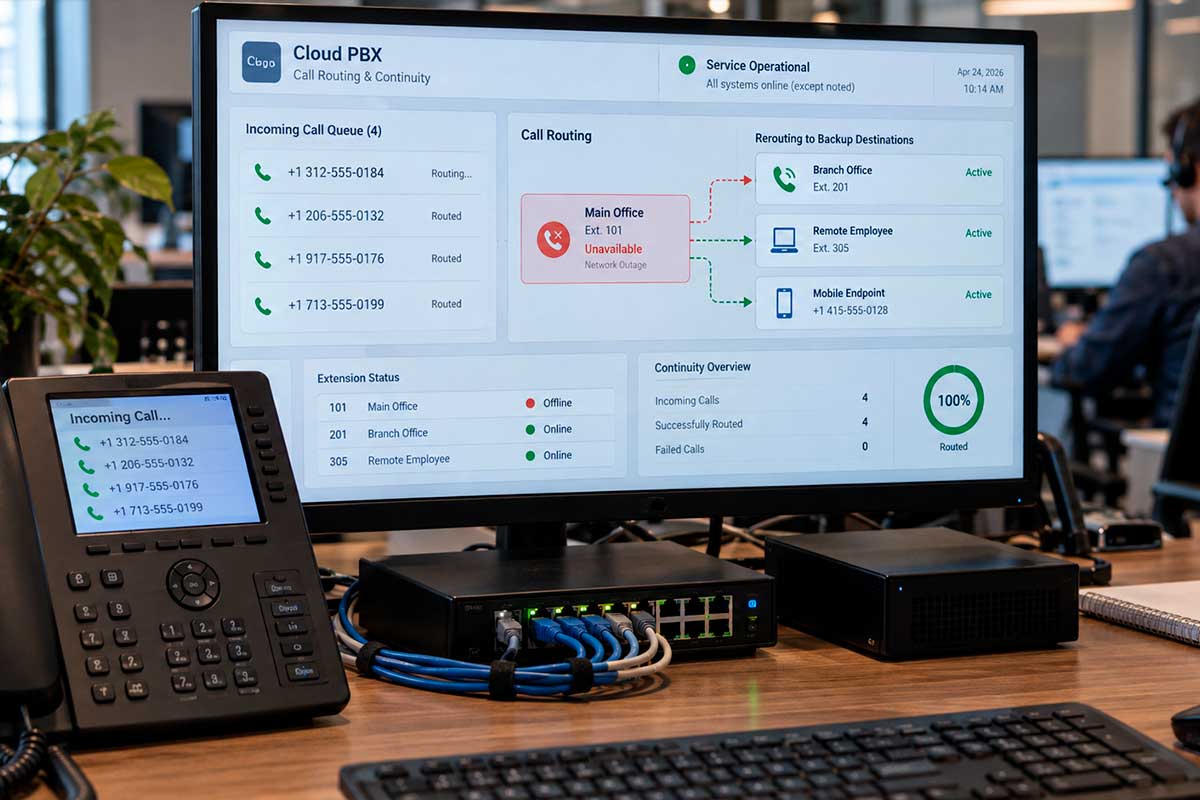
What is Virtual PBX Business Continuity?
Virtual PBX Business Continuity is the ability to maintain essential business calling when an office, Internet connection, device, route, or other communication component becomes unavailable. It combines cloud-based telephony with routing strategies, alternative endpoints, operational procedures, and recovery options designed to reduce interruption.
The distinction matters because having a PBX hosted outside the office does not automatically create a complete continuity plan. Employees may still depend on one Internet provider, one location, one set of desk phones, or one routing path. If that dependency fails and no alternative has been prepared, the organization can still lose access to important calls.
A business continuity strategy should examine where calls originate, how they enter the phone system, which users or queues normally receive them, and what alternative destinations are available when normal conditions change. This creates a practical framework for maintaining communications rather than relying on the assumption that cloud hosting alone eliminates operational risk.
You might be interested...
Direct Inward Dialing enables companies to allocate multiple phone numbers to a single PBX system, allowing customers to contact specific employees or departments directly. When a call is made to a DID number, the PBX routes it to the designated extension without requiring intervention from a receptionist.
This system integrates with cloud-based and VoIP technologies, offering advanced features such as call forwarding, voicemail-to-email, and real-time analytics. Businesses can also configure call routing rules to ensure that customer inquiries are directed to the appropriate teams, improving overall response efficiency.
What happens to business calls during an Internet outage?
When an office loses Internet access, the result depends on the architecture of the phone environment. IP phones connected exclusively through that local network may temporarily lose connectivity, while the phone number and cloud-based call logic can remain separate from the physical location if the system has been configured appropriately.
Incoming calls can potentially follow predefined routing rules toward another office, external number, mobile endpoint, remote extension, or other available destination. The important factor is that these alternatives must already exist in the communication design; trying to improvise routing after connectivity has disappeared creates unnecessary delays during an incident.
Companies evaluating their exposure should identify three basic dependencies before an outage occurs:
- Which critical numbers or departments depend on a single Internet connection or physical office.
- Which alternative users, devices, locations, or numbers can receive calls when the primary destination becomes unavailable.
- Who is responsible for activating, validating, and later restoring the normal routing configuration.
The purpose of this review is practical. A company should already know where customer calls will go if its primary reception desk, sales floor, or support location suddenly becomes unreachable.

Cloud hosting and business continuity are not the same thing
Cloud PBX architecture changes where the core phone system is hosted, but business continuity concerns the broader path that a call takes from the customer to the employee who eventually answers it. Internet connectivity, network equipment, endpoint availability, carrier routing, device configuration, and user access can all influence whether the complete communication process remains operational.
This is why a company can have a technically available cloud PBX while employees at a particular office are unable to use their desk phones. The communication platform and the local endpoint environment are related, but they are not identical. Understanding that distinction makes it easier to build realistic contingency plans.
CloudXentral currently offers functionality such as call forwarding, call transferring, hunt groups, call queues, mobile business phone capabilities, voicemail-to-email, administrative controls, and other PBX functions that can support a more distributed communication model. The business value of those capabilities becomes clearer when they are considered as parts of continuity planning rather than isolated features.
PBX failover vs call forwarding: What is the difference?
Call forwarding is a specific function that redirects a call toward another destination according to defined rules. A company may forward calls from an office number to another extension, a mobile number, another department, or an external destination when required.
PBX failover is a broader continuity concept. It refers to having alternative communication paths available when a primary component, destination, route, or location becomes unavailable. Call forwarding may be one mechanism inside that strategy, but failover can also involve multiple endpoints, alternate routing logic, distributed teams, secondary connectivity, or different operational procedures.
The easiest way to distinguish them is through their scope:
- Call forwarding changes where a particular call is sent.
- PBX failover defines how communication continues when a normal path cannot be used.
- Business continuity combines technical failover with people, procedures, testing, and recovery planning.
Treating these concepts separately helps businesses avoid assuming that one forwarding rule is enough to protect the entire phone operation.
How cloud PBX redundancy reduces single points of failure
A single point of failure is any component whose loss can interrupt an entire communication process. That component might be a physical office, one Internet circuit, a local router, a particular group of phones, or a routing configuration that sends every customer call toward the same unavailable destination.
A stronger continuity model reduces unnecessary dependence on those individual components. When employees, extensions, and call destinations can operate across multiple locations or devices, a local disruption has a better chance of remaining local instead of affecting the entire organization.
The objective is not to create unlimited duplication across every system. Businesses should identify communication functions that are operationally critical and provide reasonable alternatives for them. A sales number receiving high-value opportunities may require a different continuity strategy from an internal extension that receives very little traffic.
How multi-location businesses keep calls running during disruptions
Businesses with multiple offices have an important advantage when their communication architecture is centralized. Instead of treating each location as an isolated phone system, a cloud-based model can organize extensions, numbers, queues, and routing policies across distributed employees and offices.
If one location becomes temporarily unavailable, other parts of the organization may continue operating because they are not physically dependent on the affected office. Calls normally handled by one team can be redirected or redistributed according to the contingency structure already established by the business.
This is where Virtual PBX becomes particularly useful for companies with distributed operations. CloudXentral positions its PBX platform around virtual extensions, call routing, mobile access, hunt groups, queues, and centralized management, which can give organizations more flexibility when users must answer from another location or device.
Why mobile and desktop endpoints matter during outages
Desk phones remain useful in many business environments, but making every critical employee dependent on a physical device connected to one office creates an obvious continuity limitation. Mobile and desktop endpoints can provide another way for authorized users to access business communications when their normal workspace becomes unavailable.
The practical benefit appears during situations such as office closures, network failures, temporary relocations, or remote operations. An employee who cannot reach a physical extension may still have another approved method for receiving business communications, depending on how the PBX environment and user access have been configured.
Alternative endpoints should be treated as part of a continuity design rather than an emergency improvisation. Companies should confirm in advance which users require alternative access, how authentication works, whether devices are correctly configured, and whether employees know how to use them during a disruption.

What should a business phone continuity plan include?
A useful continuity plan should be simple enough to activate quickly but detailed enough that employees are not making routing decisions for the first time during an outage. The plan should focus on the calls that genuinely matter to customer service, revenue, operations, or other critical functions.
At minimum, businesses should document three areas:
- Alternative call destinations for critical numbers, queues, departments, and customer-facing teams.
- Remote or secondary endpoints that allow essential employees to maintain access away from the primary office.
- Clear procedures for detecting an incident, activating contingency routing, testing service, and returning to the normal configuration.
These elements should also be tested periodically. A failover route that has never been validated may contain an outdated number, unavailable user, incorrect schedule, or configuration that behaves differently from what the business expects.
How Virtual PBX supports VoIP disaster recovery
VoIP disaster recovery focuses on restoring or maintaining voice communications after a disruptive event. The event does not need to be a large-scale natural disaster; a damaged router, local Internet outage, electrical problem, office evacuation, or inaccessible building can create a meaningful communication interruption for the affected company.
A cloud-based phone environment can support recovery because numbers, extensions, and routing logic do not have to be physically tied to one traditional PBX appliance inside the office. Employees and administrators can have more options for changing destinations or continuing communication through approved alternative endpoints.
A practical recovery strategy should account for different levels of disruption:
- Endpoint failure: an individual phone or workstation becomes unavailable while the rest of the environment remains operational.
- Location failure: an entire office loses connectivity, power, or physical access and calls need another destination.
- Broader service disruption: multiple communication components are affected and documented escalation or provider support becomes necessary.
Separating these scenarios prevents businesses from using the same response for every incident and helps teams understand which recovery option makes sense for the actual failure.
Conclusion
The most important lesson is that business continuity cannot be purchased as a single feature. Cloud PBX technology provides tools that can support resilience, but companies still need to decide how calls should behave when normal conditions disappear.
A well-designed approach combines routing, alternative endpoints, distributed users, redundancy, documented responsibilities, and regular testing. That structure helps a business respond differently to an unavailable phone, an office Internet outage, or a larger service interruption instead of treating every problem as a complete PBX failure.
CloudXentral gives businesses a foundation for building that type of communication environment through its PBX and call-management capabilities. For organizations evaluating their current setup, a useful question is simple: if the main office lost Internet tomorrow, would customers still know how to reach the people who need to answer?
FAQS
A cloud PBX can provide an important foundation for disaster recovery because the core phone environment is less dependent on equipment installed in one office. Complete disaster recovery still requires planning around connectivity, endpoints, routing, alternative destinations, procedures, and provider dependencies.
Companies can improve continuity by identifying critical numbers, configuring alternative destinations, supporting remote endpoints, reducing single points of failure, documenting responsibilities, and testing their contingency routing before an incident occurs. The exact approach depends on the company’s PBX architecture and operational requirements.
Call forwarding redirects calls toward another destination according to a rule, while PBX failover is a broader continuity strategy for maintaining communications when a normal path becomes unavailable. Forwarding can be one component of failover, but it does not represent a complete continuity plan by itself.
Potentially, yes, because the business number and cloud-based PBX do not necessarily reside inside the affected office. Whether calls remain useful to the business depends on whether alternative destinations, remote users, mobile endpoints, or other contingency routes have been configured beforehand.
FOLLOW US IN YOUTUBE
You might be interested...
Contact Center Call Abandonment Businesses invest heavily in SEO, paid …
Click to Call Conversion Businesses invest heavily in SEO, paid …
Contact Center Workforce Forecasting A company can have enough customer …
Virtual PBX Business Continuity Business messaging in the United States …
 EN
EN  ES
ES
One Response