
AI Voice of Customer Analysis: Turn Calls Into Insights in 2026
AI Voice of Customer Analysis
Companies spend significant resources on surveys, NPS programs, CSAT forms, interviews, and research projects to understand what customers think. At the same time, those customers are already describing problems, expectations, objections, frustrations, and priorities every day during sales and service calls. Much of that information disappears once the conversation ends.
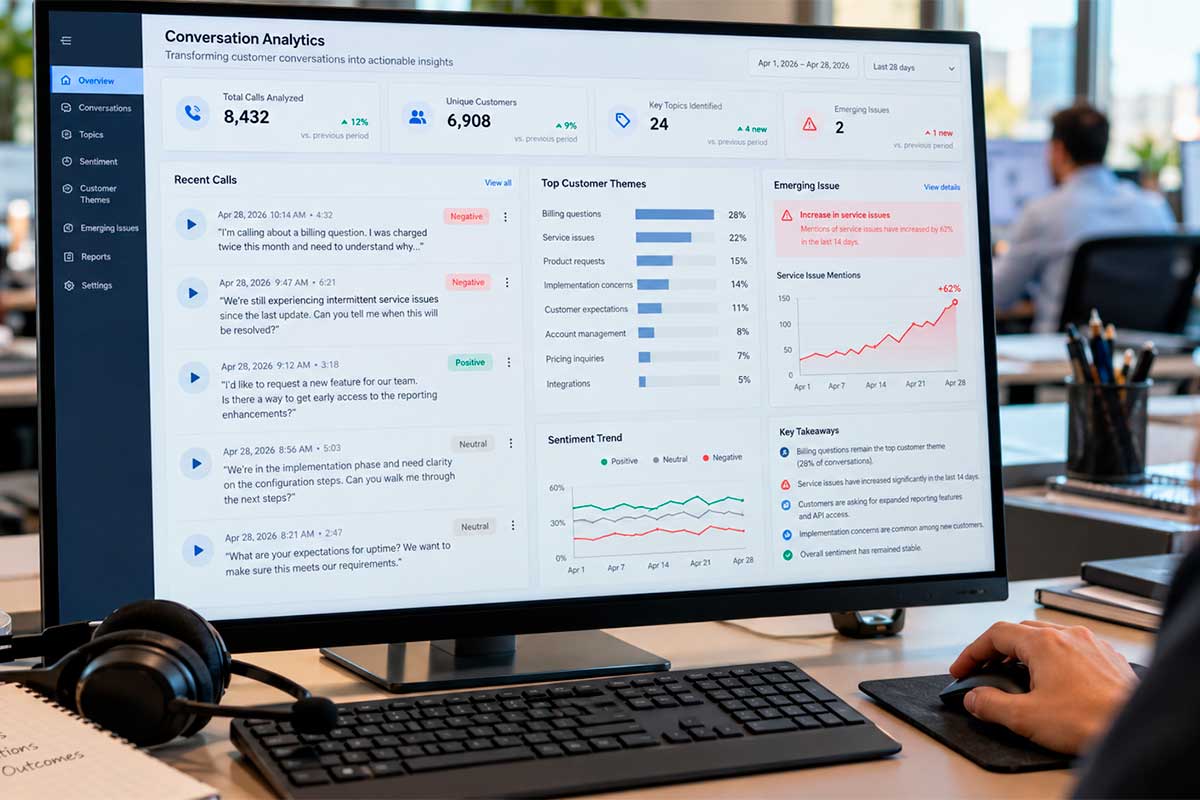
AI Voice of Customer Analysis changes that dynamic by treating calls as a continuous source of customer intelligence. Instead of reviewing conversations only when there is a complaint or quality issue, businesses can analyze large volumes of customer interactions to identify recurring themes, changing needs, and signals that may deserve operational or strategic attention.
The opportunity is especially relevant in 2026 because companies are collecting more conversational data across sales, customer service, technical support, billing, and retention. The challenge is no longer simply recording those interactions. The challenge is learning what customers are consistently saying across thousands of conversations and turning that information into something decision-makers can use.
What is AI Voice of Customer Analysis?
AI Voice of Customer Analysis is the process of using artificial intelligence to organize, interpret, and compare customer feedback contained in conversations. The goal is to identify patterns across a large number of interactions rather than treating each call as an isolated event.
A Voice of Customer program traditionally relies on structured feedback such as surveys, satisfaction scores, interviews, and reviews. Conversational analysis adds another source: the spontaneous language customers use when they contact the company because they need information, want to solve a problem, are considering a purchase, or are reacting to an experience.
That distinction matters because unsolicited feedback often reveals issues that a company did not think to ask about. A customer may repeatedly mention difficulty understanding a bill, confusion about activation, unexpected pricing, or a missing feature without ever completing a survey about those topics.
You might be interested...
Direct Inward Dialing enables companies to allocate multiple phone numbers to a single PBX system, allowing customers to contact specific employees or departments directly. When a call is made to a DID number, the PBX routes it to the designated extension without requiring intervention from a receptionist.
This system integrates with cloud-based and VoIP technologies, offering advanced features such as call forwarding, voicemail-to-email, and real-time analytics. Businesses can also configure call routing rules to ensure that customer inquiries are directed to the appropriate teams, improving overall response efficiency.
Why customer calls are an overlooked Voice of Customer source
A survey reflects the questions the company decided to ask. A phone conversation can reveal the questions customers actually want answered.
This difference creates strategic value. A business may believe that pricing is its main sales objection because that is what its surveys measure, while conversations reveal that implementation time, contract conditions, compatibility, or internal approval requirements are preventing more deals from moving forward.
Customer service calls can provide similar insight. If customers repeatedly describe the same step as confusing, the issue may exist in the process rather than in individual agent performance. When those patterns become visible across hundreds of interactions, the organization gains a more complete picture of customer friction.
Surveys vs. customer conversations: What is the difference?
Surveys provide structured data that is relatively easy to compare over time. They can measure satisfaction, loyalty, effort, or responses to specific questions using consistent scales. Their strength is standardization.
Customer conversations provide richer context because customers speak in their own words. They may describe the sequence of events that caused a problem, mention alternatives they considered, explain why a policy is frustrating, or reveal what they expected before contacting the company.
The strongest Voice of Customer strategy can use both. Surveys can measure a known issue consistently, while conversation analysis can uncover issues that are still emerging or explain why a score is changing.

How AI identifies recurring customer issues across thousands of calls
Listening manually to a small number of calls can reveal useful details, but it does not provide a reliable view of what is happening across an entire operation. Teams can easily overestimate unusual cases simply because those calls were memorable or happened to be selected for review.
AI Voice of Customer Analysis makes it possible to group related conversations around common business themes. Customers may use different phrases to describe the same underlying issue, so effective analysis needs to look beyond exact keywords and identify semantic relationships between what callers are saying.
This is where Vocametrics can become especially valuable. Rather than treating transcription, sentiment, summaries, and conversation analysis as separate features, businesses can use them together to understand what customers are talking about repeatedly and how those themes change across larger volumes of calls.
How Voice of Customer insights help different business teams
Voice of Customer data becomes more valuable when it reaches the teams capable of acting on it. The same group of conversations may reveal different opportunities depending on whether the reader is responsible for product development, sales, marketing, operations, or customer experience.
Product & Operations: recurring complaints can reveal confusing processes, product limitations, service failures, or workflows that create unnecessary effort.
Sales & Marketing: conversations can expose objections, buying criteria, competitor mentions, frequently requested information, and the language prospects use to describe their needs.
Customer Experience: repeated friction points can help teams identify where expectations break down and which issues affect the customer journey most often.
The objective is not to distribute every conversation throughout the organization. Teams need summarized patterns supported by enough context to understand why a topic matters and whether the evidence is strong enough to justify action.
Customer language can reveal what buyers actually care about
Marketing teams often describe products using internal terminology, while customers describe the same needs in completely different language. Calls provide direct access to the vocabulary buyers naturally use when explaining problems, asking questions, or comparing alternatives.
A software company may promote advanced integration capabilities, while prospects repeatedly ask whether implementation requires internal IT resources. A communications provider may emphasize features while customers focus more heavily on reliability, onboarding, response times, or scalability.
Analyzing those conversations can improve market understanding because teams are working with language that appeared naturally during real interactions. This does not turn Voice of Customer analysis into keyword research; it provides qualitative and quantitative context about how customers frame their priorities.

How Emerging Customer Themes reveal changing needs
The most frequently mentioned topic is not always the most important topic to investigate. A theme that has existed for years may dominate conversation volume while a smaller issue is increasing rapidly and could become much more significant.
Emerging Customer Themes are topics whose frequency, context, or business relevance changes over time. A new policy might initially appear in a small number of support calls, then begin showing up more often as additional customers encounter it.
This type of trend analysis helps organizations move beyond static reports. Instead of asking only “What are customers talking about most?”, the business can also ask “What are customers starting to talk about more than they did last month?”
From recurring feedback to root cause analysis
Finding a recurring complaint is the beginning of the investigation, not the conclusion. A billing complaint could be caused by an accounting error, confusing invoice language, incorrect expectations created during the sales process, or a customer misunderstanding.
A useful Voice of Customer workflow should move through three stages:
Signal: identify a topic, complaint, question, or behavior that is appearing repeatedly or growing faster than expected.
Context: review representative conversations to understand what customers were experiencing and what occurred before the issue was mentioned.
Root cause: determine whether the pattern is connected to a process, product, policy, communication gap, operational failure, or another underlying factor.
AI can help organize the evidence and surface relevant conversations, but business teams still need to interpret the context before making changes. A repeated theme is a reason to investigate, not proof that one specific explanation is correct.
Can Voice of Customer trends provide early warning signals?
Traditional reports often describe problems after they have already become visible through complaints, cancellations, satisfaction scores, or escalations. Conversational trends can sometimes provide earlier evidence because customers begin discussing the issue as soon as they experience it.
Suppose a new activation process launches on Monday. Only a small number of customers mention it during the first week, but those mentions increase steadily and begin appearing across both customer service and sales calls. The absolute volume may still be low, yet the direction of the trend deserves attention.
AI Voice of Customer Analysis helps teams find these patterns earlier by comparing what customers are discussing across time periods. The analysis should be treated as an early signal that deserves validation rather than an automated conclusion about what the business needs to change.
How Vocametrics turns conversations into continuous customer intelligence
The strongest use of Vocametrics in a Voice of Customer strategy is not simply analyzing individual calls. Its value comes from helping organizations transform large volumes of conversations into structured information that can be reviewed across interactions.
Transcripts provide the raw language customers used. Conversation analysis helps organize themes and patterns. Sentiment can add emotional context to specific issues, while summaries can make representative calls easier to understand without requiring managers to listen to the entire recording.
When these capabilities are applied across a substantial conversation set, the business can move from anecdotal feedback toward evidence-based customer listening. Instead of relying on one memorable complaint, teams can investigate whether the same issue appears repeatedly and whether its frequency is changing.

AI Voice of Customer Analysis in 2026
The evolution of Voice of Customer programs is moving toward broader and more continuous listening. Surveys remain valuable, but they capture only part of what customers communicate to a business.
Calls contain details that customers choose to mention because those issues matter enough to drive a conversation. AI makes it possible to analyze that information at a scale that manual call review could never sustain consistently.
The strongest implementation is not designed to create more reports. It should help businesses discover what customers are repeatedly saying, identify what is beginning to change, investigate why those patterns exist, and connect the findings with teams capable of acting on them.
FAQS
AI Voice of Customer Analysis uses artificial intelligence to identify recurring topics, trends, needs, complaints, and other customer signals across large volumes of conversations. It helps organizations transform individual calls into structured customer intelligence that can support product, operational, marketing, sales, and customer experience decisions.
Yes. Customer calls contain direct feedback about problems, expectations, objections, service experiences, and buying decisions. They can complement surveys and other structured feedback sources because customers often discuss issues spontaneously using their own language.
Unsolicited Voice of Customer feedback is information customers provide without being directly asked through a survey or research question. Comments made during sales, support, billing, and service conversations are examples because the customer decides which topics to raise based on their immediate experience.
Surveys use predefined questions to collect structured feedback, while Voice of Customer analytics can examine broader signals contained in natural conversations, reviews, messages, or other interactions. Surveys are effective for consistently measuring known questions, while conversations can reveal needs or problems the company had not previously identified.
FOLLOW US IN YOUTUBE
You might be interested...
AI Voice of Customer Analysis Companies spend significant resources on …
Contact Center Call Abandonment A customer calls because they need …
Click to Call Conversion Businesses invest heavily in SEO, paid …
Contact Center Workforce Forecasting A company can have enough customer …
 EN
 ES