Call Compliance Monitoring Software: How AI Reduces Legal Risks 2026
Call Compliance Monitoring Software
Healthcare providers must communicate privacy notices and obtain specific authorizations. Financial institutions are required to disclose investment risks, fees, and regulatory statements. Insurance companies must explain coverage limitations. Telecommunications providers frequently operate under consumer protection regulations, while organizations handling payment information must comply with strict security standards.
These legal obligations are not optional. They are part of everyday customer interactions, and a single omission can expose an organization to regulatory investigations, financial penalties, customer disputes, or reputational damage.
Despite the importance of compliance, many businesses continue relying on manual monitoring processes that review only a fraction of customer conversations. Supervisors cannot realistically verify thousands of daily interactions, creating operational blind spots where compliance failures often remain undetected until a complaint, internal audit, or regulatory inquiry occurs.
Why Compliance Monitoring Has Become a Strategic Business Priority
Compliance is often associated with legal departments, regulatory agencies, or internal audits. In reality, it begins with the people speaking directly with customers every day.
Customer service representatives, sales professionals, appointment coordinators, financial advisors, healthcare specialists, and support agents are responsible for communicating information that may have legal implications. During these conversations, they must follow approved scripts, explain contractual conditions, obtain customer consent, and communicate mandatory disclosures with precision.
This responsibility becomes increasingly difficult as organizations grow.
A company operating hundreds of agents across multiple offices may process tens of thousands of conversations every week. Each interaction represents another opportunity to build customer trust, but it also introduces another potential compliance risk.
Supervisors understand the importance of monitoring these conversations. However, reviewing every call manually is beyond the capacity of even the largest Quality Assurance departments. As communication volumes increase, compliance teams are forced to prioritize selected recordings rather than reviewing every interaction. While this sampling approach has existed for many years, modern customer service environments have exposed its limitations.
You might be interested...
Direct Inward Dialing enables companies to allocate multiple phone numbers to a single PBX system, allowing customers to contact specific employees or departments directly. When a call is made to a DID number, the PBX routes it to the designated extension without requiring intervention from a receptionist.
This system integrates with cloud-based and VoIP technologies, offering advanced features such as call forwarding, voicemail-to-email, and real-time analytics. Businesses can also configure call routing rules to ensure that customer inquiries are directed to the appropriate teams, improving overall response efficiency.
The Hidden Risks of Manual Compliance Reviews
Many organizations assume that regular call monitoring provides an accurate picture of compliance performance. Unfortunately, manual reviews often reveal only a small portion of what actually happens across daily operations.
A supervisor may evaluate a limited number of conversations each week, searching for adherence to internal procedures and regulatory requirements. Those reviews are valuable, yet they rarely reflect every interaction handled by an entire Contact Center.
This creates significant operational uncertainty.
An agent may unintentionally skip a required privacy disclosure during dozens of customer conversations before the issue appears in a sampled recording. Another representative may consistently use language that creates unnecessary legal exposure without supervisors realizing the pattern exists.
The challenge becomes even greater when different regulations apply depending on the customer’s location, product category, or service requested. Maintaining consistent oversight through manual reviews alone becomes increasingly difficult as operational complexity grows.
Several compliance risks commonly emerge from this environment
- Mandatory legal disclosures may be omitted during high-volume periods.
- Customer consent may not be communicated consistently across every interaction.
- Privacy notices may vary between agents, departments, or office locations.
Each of these situations increases regulatory exposure while making internal investigations more difficult should questions arise later.
Organizations operating in highly regulated industries recognize that detecting these issues after they occur is considerably more expensive than preventing them in real time.

Compliance Failures Rarely Begin With Intentional Misconduct
One of the biggest misconceptions surrounding compliance is the belief that violations occur because employees intentionally ignore regulations. In reality, many compliance incidents are the result of ordinary operational pressures.
Agents work under demanding conditions where they must answer customer questions, solve problems, navigate multiple software applications, document interactions, and maintain productivity targets throughout the day. Under these circumstances, forgetting a required disclosure or slightly altering approved language can happen even among experienced employees.
This human factor explains why traditional compliance programs often struggle despite extensive training. Annual certification courses, updated documentation, and periodic coaching remain essential components of regulatory governance. However, they cannot guarantee that every mandatory statement will be communicated correctly during thousands of real customer conversations.
The challenge is amplified by employee turnover, seasonal staffing, new product launches, regulatory updates, and evolving customer expectations. Every operational change introduces additional variables that supervisors must monitor.

The Financial and Reputational Cost of Delayed Detection
Compliance failures extend far beyond regulatory penalties.
When organizations fail to detect communication risks quickly, the consequences often affect multiple areas of the business. Customer trust may decline if required information was omitted during important conversations. Internal investigations consume valuable resources. Legal teams spend significant time reviewing recordings manually, while supervisors attempt to reconstruct events that may have occurred weeks earlier.
Financial consequences can include regulatory fines, litigation costs, remediation programs, operational disruptions, and increased audit requirements. Equally important is the reputational impact that accompanies public compliance failures. Customers expect organizations to communicate transparently and handle sensitive information responsibly.
For industries such as healthcare, financial services, insurance, telecommunications, and professional consulting, maintaining consistent communication standards is essential to protecting both customers and the business itself.
These realities have changed the role of compliance monitoring
Rather than functioning as an occasional review process, it is becoming a continuous operational capability designed to identify potential risks before they escalate into larger legal or financial issues.
This shift is driving organizations to reconsider the capabilities they expect from modern call compliance monitoring software.
Verifying Mandatory Disclosures Automatically
Many industries require agents to communicate specific legal statements during customer interactions. These disclosures may relate to privacy practices, consent requirements, financial obligations, contractual limitations, healthcare regulations, or consumer rights. Missing even a single required statement can create compliance concerns depending on the applicable regulatory framework.
Manual monitoring makes it difficult to verify that these disclosures were communicated consistently throughout thousands of daily conversations.
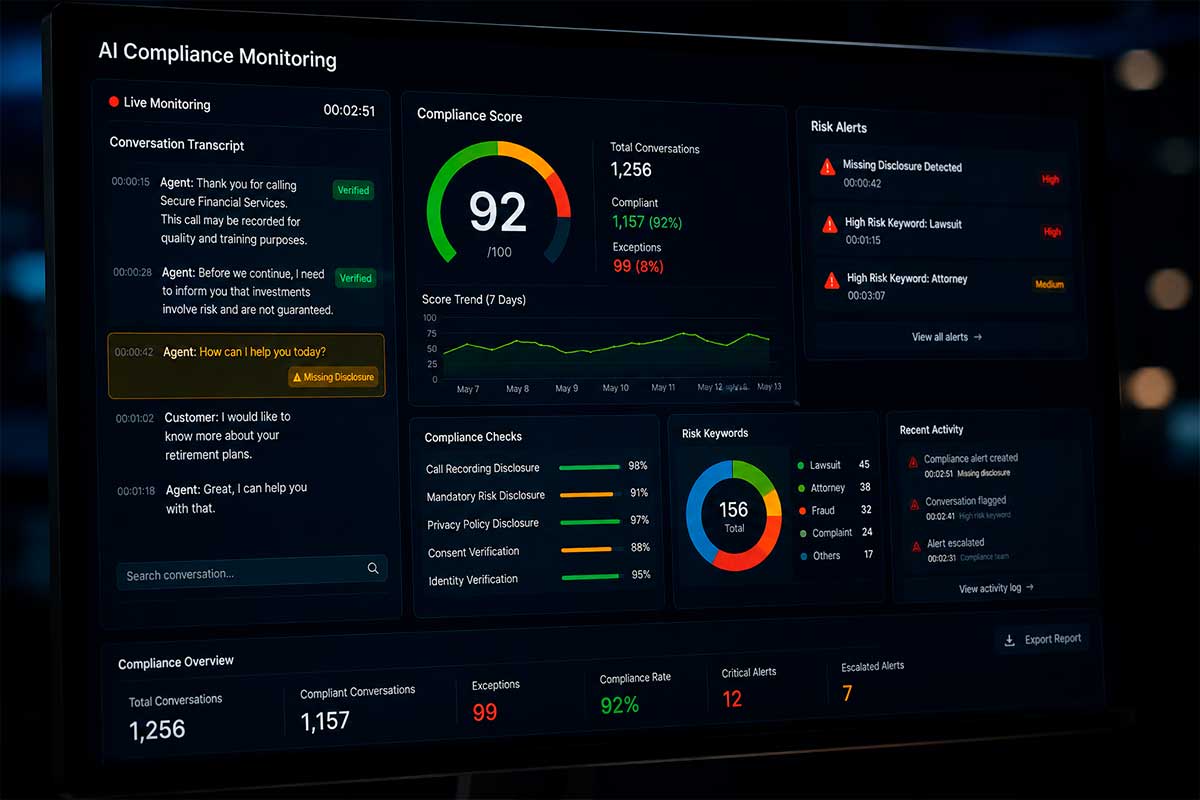
Modern call compliance monitoring software addresses this challenge by analyzing conversation transcripts automatically. Artificial intelligence compares spoken language against predefined compliance requirements, identifying whether mandatory phrases were communicated completely, partially, or omitted altogether.
Rather than asking supervisors to manually search through recordings, the system continuously verifies compliance across every evaluated conversation.
Strengthening Compliance Through an Integrated Communications Ecosystem
Compliance monitoring becomes more effective when conversation analysis is closely connected to the communication platform itself.
Within the CloudXentral ecosystem, Cloud Call Center provides the centralized environment where customer interactions are managed, distributed, and recorded across customer service, sales, technical support, and other operational teams.
Because communications are managed through a unified cloud platform, organizations benefit from greater consistency in routing, recording, supervision, and operational visibility.
Conversation intelligence adds another layer to this environment by transforming customer interactions into measurable compliance data that supervisors can evaluate continuously.
For organizations operating multiple offices or supporting remote workforces, Cloud PBX contributes to standardized business communications by centralizing extensions, call routing, and communication management. A unified communication environment helps reduce operational inconsistencies while simplifying governance across distributed teams.

Objective Reporting Supports Better Compliance Decisions
Effective compliance management depends on accurate information.
Traditional reporting often reflects a limited collection of manually reviewed calls, making it difficult to determine whether identified issues represent isolated events or broader operational trends.
By continuously analyzing conversations across the organization, Vocametrics provides compliance managers with measurable insights supported by complete datasets rather than statistical estimates.
These analytics help organizations answer practical questions such as:
- Are mandatory disclosures being delivered consistently across every department?
- Which compliance requirements generate the highest number of exceptions?
- Are coaching initiatives reducing recurring compliance issues?
- Which operational teams require additional training or process improvements?
Access to this information allows leadership teams to make more informed decisions regarding workforce development, internal policies, compliance procedures, and operational governance.
Instead of reacting to isolated incidents, organizations gain the ability to identify long-term trends and strengthen compliance programs proactively.
Conclusion
Traditional monitoring methods provide valuable oversight, yet they cannot keep pace with the communication volumes generated by modern Contact Centers. Reviewing a limited sample of conversations leaves organizations vulnerable to undetected compliance gaps that may lead to financial penalties, operational disruption, or reputational damage.
Modern call compliance monitoring software changes this approach by using artificial intelligence to evaluate conversations consistently, verify mandatory disclosures, identify high-risk language, and generate objective compliance insights across the entire operation.
Within CloudXentral’s communications ecosystem, Vocametrics helps organizations transform compliance monitoring into a continuous, data-driven process. Combined with Cloud Call Center and Cloud PBX, businesses gain an integrated cloud communications environment that supports stronger governance, faster risk detection, and more consistent regulatory compliance without increasing operational complexity.
FAQS
Call compliance monitoring software is a technology that analyzes customer conversations to verify whether agents follow regulatory requirements, company policies, and mandatory communication procedures. Modern solutions use artificial intelligence to automate this process and improve oversight across large communication environments.
Organizations operating in healthcare, financial services, insurance, telecommunications, legal services, and other regulated industries benefit significantly from AI-powered compliance monitoring because these sectors frequently require mandatory disclosures, customer consent verification, and documented communication standards.
Yes. Advanced conversation intelligence platforms can compare spoken conversations against predefined compliance requirements, identifying omitted statements, incomplete disclosures, or deviations from approved communication scripts that require supervisory review.
Artificial intelligence evaluates conversations consistently across the entire operation, allowing organizations to identify compliance risks much faster than traditional sampling methods. This improves operational visibility while reducing dependence on time-consuming manual reviews.
An integrated cloud communications platform centralizes customer interactions, recordings, routing, and conversation analytics within a single environment. This improves consistency across departments, simplifies compliance management, and provides more reliable operational reporting for supervisors and legal teams.
FOLLOW US IN YOUTUBE
You might be interested...
Click to Call Conversion Businesses invest heavily in SEO, paid …
Contact Center Workforce Forecasting A company can have enough customer …
Virtual PBX Business Continuity Business messaging in the United States …
RCS Business Messaging in US Business messaging in the United …
 EN
EN  ES
ES
2 Responses