
Telecommunications Service Provider with AI: The Future of Business Communications 2026
Telecommunications Service Provider with AI
For decades, businesses evaluated telecommunications providers using a relatively simple checklist. Reliable voice quality, competitive pricing, business phone numbers, and technical support were enough to satisfy most organizations. That reality has changed dramatically. Modern companies generate an enormous amount of information through every customer conversation, yet much of that data disappears once the call ends.
Business leaders are beginning to ask a different question. Instead of looking for a provider capable of transporting voice traffic efficiently, they want to understand how communications themselves can improve operational performance. Phone calls are no longer isolated events between an employee and a customer. They represent a continuous stream of information capable of revealing customer satisfaction, purchasing intent, operational inefficiencies, training needs, and compliance risks.
This evolution explains why the role of a telecommunications service provider with AI extends far beyond delivering connectivity. Artificial intelligence is reshaping business communications by transforming conversations into measurable operational intelligence that supports better decisions across sales, customer service, compliance, and executive management.
The Evolution of Business Telecommunications in the United States
The telecommunications industry has undergone one of its most significant transformations since businesses began adopting Voice over IP technologies. Cloud computing, distributed workforces, SaaS applications, and unified communications have changed the expectations companies place on their communication infrastructure.
A growing number of organizations operate across multiple states, manage hybrid workforces, and support customers through centralized Contact Centers. Under these conditions, communication systems must provide far more than dial tone and call routing. They have become part of the operational backbone that connects employees, customers, partners, and business applications.
This shift has also increased the amount of operational data generated through daily communications. Every inbound inquiry, technical support request, sales conversation, and customer complaint contributes valuable information about how the business performs. Organizations capable of capturing and interpreting that information gain a competitive advantage because they understand customer behavior with far greater precision than companies relying solely on traditional reporting.
You might be interested...
Direct Inward Dialing enables companies to allocate multiple phone numbers to a single PBX system, allowing customers to contact specific employees or departments directly. When a call is made to a DID number, the PBX routes it to the designated extension without requiring intervention from a receptionist.
This system integrates with cloud-based and VoIP technologies, offering advanced features such as call forwarding, voicemail-to-email, and real-time analytics. Businesses can also configure call routing rules to ensure that customer inquiries are directed to the appropriate teams, improving overall response efficiency.
Why Businesses Need More Than Traditional Communication Services
Many organizations continue investing heavily in marketing, customer acquisition, employee training, and operational improvements. Despite these investments, one of their richest information sources often remains underutilized: everyday customer conversations.
A sales call may reveal recurring objections that prevent prospects from purchasing. A support interaction may expose product issues affecting customer satisfaction. A billing conversation may uncover confusion about pricing structures. Leadership teams frequently remain unaware of these patterns because manually reviewing thousands of recordings is simply not practical.
Traditional telecommunications providers excel at delivering communication infrastructure, but infrastructure alone does not explain why conversations succeed or fail. Once a call is completed, organizations still face the challenge of understanding what actually happened during that interaction.
Business performance increasingly depends on answering questions such as
- Why are customers requesting cancellations?
- Which conversations generate the highest conversion rates?
- What communication patterns produce better customer experiences?
- Which recurring issues require operational improvements?
Without objective answers, management decisions often rely on assumptions rather than measurable evidence.

The Operational Challenges Hidden Inside Daily Customer Conversations
Every business depends on communication, yet relatively few organizations fully understand the operational complexity hidden within thousands of customer interactions. Customer service teams handle questions that reveal product weaknesses, sales representatives encounter objections that may indicate pricing concerns or competitive pressure, technical support agents receive recurring requests that expose opportunities for process improvement, and supervisors attempt to evaluate employee performance while listening to only a small fraction of recorded conversations.
Managers rarely have enough time to identify every interaction that requires coaching, which means customer dissatisfaction can remain unnoticed until complaints begin to increase. Valuable sales techniques developed by top-performing representatives are often overlooked because there is no practical way to compare communication patterns across the entire organization when only a small percentage of calls are reviewed.
Locating a specific discussion among thousands of hours of recorded audio can consume valuable time, and even when recordings are available, extracting useful business insights manually becomes increasingly difficult as communication volumes continue to grow. As a result, organizations accumulate massive amounts of conversational data while lacking the operational intelligence needed to make faster and better decisions.

Why Artificial Intelligence Is Reshaping Telecommunications Services
Artificial intelligence is redefining the role of enterprise communications. In the past, communication systems were designed to transport voice from one person to another as reliably as possible. Today, businesses expect every interaction to contribute measurable value. The quality of a phone call is still important, but executives are increasingly interested in the information generated during that conversation and how it can influence business decisions.
This change reflects the growing importance of data-driven management. Organizations invest heavily in CRM platforms, business intelligence solutions, and operational dashboards because they recognize that accurate information leads to better decisions. Voice communications have traditionally remained outside that analytical ecosystem, despite representing one of the richest sources of customer feedback available. Artificial intelligence closes that gap by transforming spoken conversations into structured business information.
Companies that embrace this evolution gain visibility into customer expectations, employee performance, operational risks, and market trends without introducing additional manual work into their daily operations.
Conversations Have Become One of the Most Valuable Business Assets
Customer conversations have become one of the most valuable sources of operational intelligence available to modern businesses. A prospect may explain why they chose a competitor, a long-term customer may reveal early signs of dissatisfaction before deciding to leave, and a support interaction can expose recurring product issues that engineering teams have not yet identified. Sales representatives also uncover purchasing motivations that rarely appear in CRM reports or marketing analytics, making every conversation a potential source of strategic insight.
For many years, most of this information disappeared once the call ended. Although organizations stored recordings for legal purposes or occasional quality reviews, manually analyzing thousands of hours of audio was unrealistic. Valuable knowledge remained buried inside recordings because there was no practical way to transform spoken conversations into structured business information.
Artificial intelligence changes this model by converting conversations into searchable, measurable, and actionable datasets. Customer sentiment, recurring topics, sales objections, operational bottlenecks, successful communication techniques, and service opportunities become visible through continuous analysis instead of isolated manual reviews.
From Voice Communication to Operational Intelligence
One of the greatest advantages of AI in telecommunications is its ability to transform conversations into useful business information rather than simply automating repetitive tasks. Managers continue making strategic decisions, supervisors remain responsible for coaching their teams, and sales representatives still build customer relationships. The difference is that every decision can now be supported by objective insights extracted from customer interactions instead of assumptions or isolated observations.
Organizations can identify communication patterns, understand why certain conversations achieve better outcomes, detect recurring customer concerns, and measure service quality more accurately. As communications become a reliable source of operational intelligence, businesses gain the visibility needed to improve customer experience and make better-informed decisions.

Why Traditional Reporting Leaves Critical Blind Spots
Most businesses already rely on CRM platforms, help desk systems, and operational dashboards to measure performance. While these tools provide valuable metrics, they rarely explain what customers actually said or why a conversation ended successfully or unsuccessfully.
Conversation intelligence fills that gap by analyzing spoken interactions alongside traditional business metrics. Combining quantitative reports with AI-driven conversational insights gives managers a much clearer understanding of customer behavior, employee performance, and operational challenges, allowing them to make decisions based on complete information instead of partial data.
Vocametrics: Adding Intelligence to Enterprise Communications
Understanding what happened during a customer conversation is valuable. Understanding why it happened and identifying recurring patterns across thousands of interactions is where artificial intelligence begins to change business operations.
This is the role of Vocametrics within the CloudXentral ecosystem.
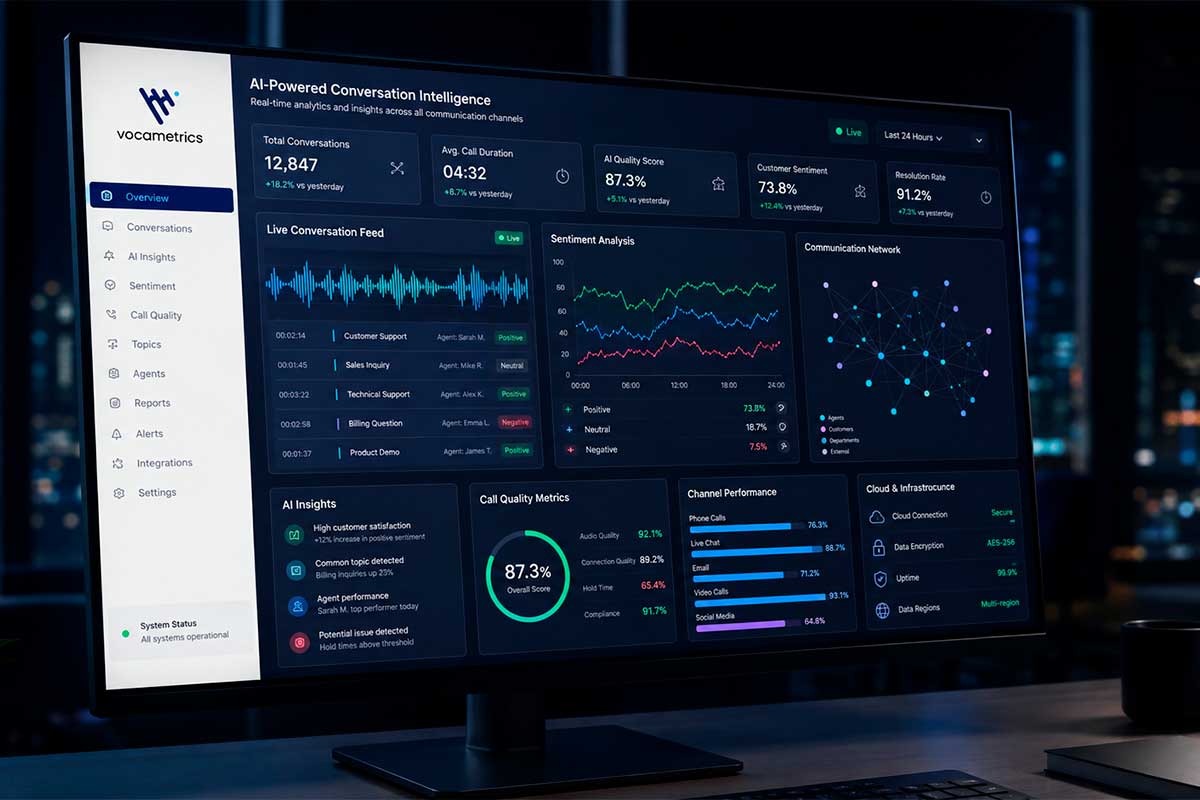
Rather than functioning as a conventional call recording platform, Vocametrics acts as an AI-powered conversation intelligence layer that continuously analyzes business communications. Every recorded interaction becomes structured information that managers, supervisors, compliance teams, and executives can use to improve operational performance.
Instead of asking supervisors to manually search through recordings, artificial intelligence automatically organizes conversations into measurable insights that help organizations understand customer behavior, employee performance, operational risks, and communication trends.
The result is a telecommunications environment where every conversation contributes to business intelligence instead of remaining archived as unused historical data.
Supporting a Smarter Telecommunications Infrastructure
Artificial intelligence delivers the greatest value when it operates as part of an integrated communications environment rather than as a disconnected analytical tool.
CloudXentral provides the cloud communications infrastructure that enables organizations to centralize business telephony, unified communications, mobility, and collaboration across distributed teams.
Within this environment, Vocametrics extends the value of every interaction by transforming communication data into operational intelligence.
Instead of viewing telecommunications as a standalone technical service, businesses gain an ecosystem where infrastructure and analytics work together. Voice communications become measurable business assets that support strategic planning, workforce development, customer experience initiatives, compliance monitoring, and continuous operational improvement.
This integrated approach reflects the direction in which enterprise telecommunications continues evolving across the United States.
Conclusion
The role of a telecommunications service provider with AI has evolved far beyond delivering reliable voice services. Modern organizations expect their communications infrastructure to generate business intelligence capable of improving customer experience, operational efficiency, regulatory compliance, and strategic decision-making.
Artificial intelligence makes this possible by transforming conversations into structured operational data that can be analyzed continuously across the organization.
Within this new communications model, Vocametrics enables businesses to unlock the full value of their customer interactions through AI-powered conversation intelligence. Integrated with CloudXentral’s communications ecosystem, it helps organizations convert everyday conversations into measurable insights that support smarter decisions, stronger customer relationships, and sustainable business growth.
FAQS
AI helps businesses identify communication patterns, optimize customer engagement strategies, improve workforce performance, strengthen compliance efforts, and make more informed strategic decisions based on real conversational data collected throughout daily operations.
Organizations increasingly recognize that customer conversations contain valuable operational information. AI enables companies to analyze those interactions at scale, improving visibility into customer behavior, service quality, sales performance, and operational efficiency without requiring extensive manual review.
Yes. Artificial intelligence enhances customer experience by providing employees with better information, identifying coaching opportunities, detecting service issues earlier, and helping managers optimize communication processes. Human relationships remain at the center of customer interactions.
Conversation intelligence transforms customer interactions into structured information that helps organizations understand customer sentiment, identify recurring issues, evaluate employee performance, detect operational risks, and improve decision-making across multiple departments.
A traditional telecommunications provider focuses primarily on connectivity, voice quality, and call routing. An AI-powered telecommunications provider expands those capabilities by analyzing conversations, generating operational insights, identifying customer trends, and supporting data-driven business decisions through artificial intelligence.
FOLLOW US IN YOUTUBE
You might be interested...
Contact Center Call Abandonment Businesses invest heavily in SEO, paid …
Click to Call Conversion Businesses invest heavily in SEO, paid …
Contact Center Workforce Forecasting A company can have enough customer …
Virtual PBX Business Continuity Business messaging in the United States …
 EN
EN  ES
ES
2 Responses